Goal
Provide an objective, repeatable measurement of emotional expression by recording standardized finger-pressure waveforms and extracting universal dynamic patterns for each emotion.
Problem
The lack of quantitative, reproducible methods for studying human emotions and their physiological correlates.
Concept Summary
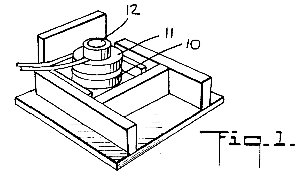
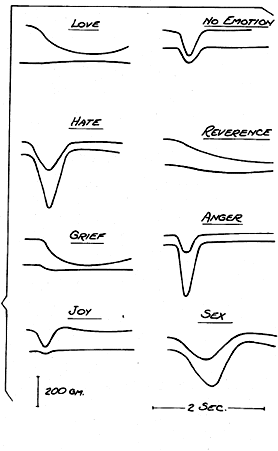
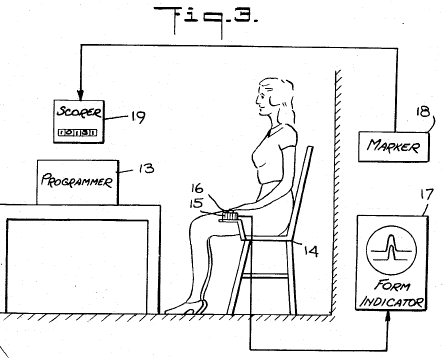
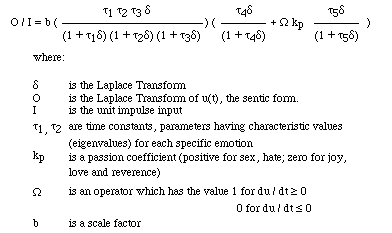
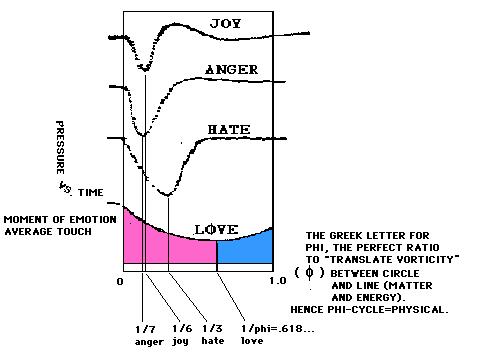
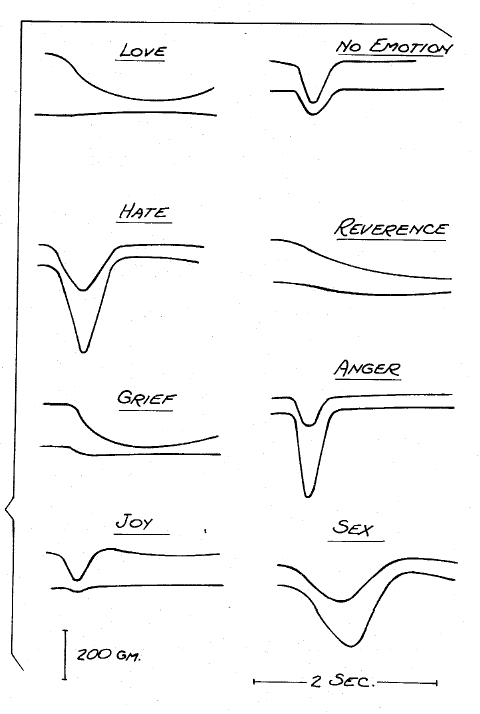
A subject rests a finger on a calibrated rest equipped with two pressure transducers (vertical and horizontal). At random auditory cues the subject briefly presses the finger, attempting to express a pre-selected fantasy emotion (e.g., anger, love, joy). The pressure waveforms are recorded, averaged across many trials, and characteristic dynamic shapes ("sentic forms") are identified for each emotion. Correlation analysis shows high intra-subject stability and cross-cultural similarity, suggesting universal brain-programmed movement patterns.
Principles
- Universal brain-programmed movement patterns for emotions
- Standardized finger-pressure transduction
- Averaging of multiple transient recordings (CAT)
- Correlation-based pattern recognition
Scientific Domains
Materials
- Pressure transducer (piezoelectric or strain-gauge)
- Finger rest (plastic or metal)
- Computer for data acquisition and analysis
Mechanisms of Action
- Mechanical pressure of finger transduced into electrical signal
- Signal averaging to derive a common waveform per emotion
- Statistical correlation to assess reproducibility
Energy Sources
Applications
- Therapeutic emotion training
- Human-computer interaction
- Music performance analysis
- Cross-cultural emotion research
Claimed Performance
Intra-subject correlation >0.90 for the same emotion; inter-subject correlation >0.80; distinct waveforms for at least seven basic emotions.
Experimental Evidence
Experiments with subjects from the United States, Mexico, Japan, and Indonesia showed consistent pressure waveforms for each emotion; statistical correlations indicated high repeatability and cross-cultural similarity.
Limitations
- Requires subject imagination and cooperation
- Limited to finger-pressure modality
- Potential language-based interpretation differences
- No real-time feedback in the described method