Goal
Produce a high-strength, lightweight steel with superior ductility and toughness in a fraction of the time and cost of conventional heat-treatment processes.
Problem
Traditional steel making requires long heating cycles, expensive equipment, hazardous quenching fluids, and extensive processing time, limiting throughput and increasing cost.
Concept Summary
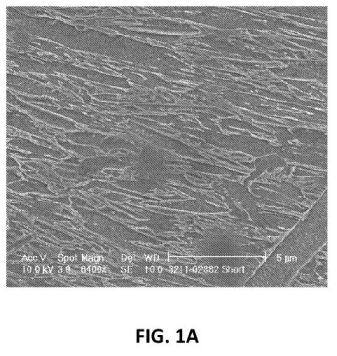
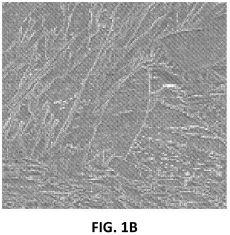
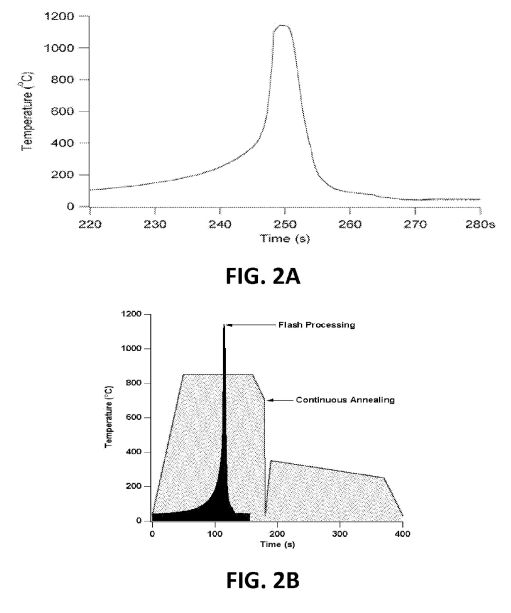
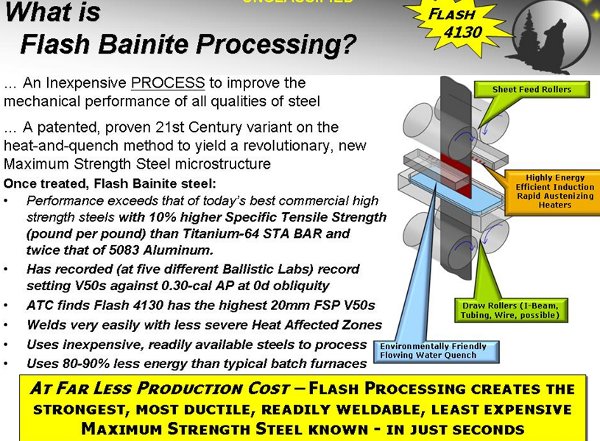
Flash Bainite is a rapid micro-treatment process that heats iron-based alloys at rates of 600-5 000 deg F/s to above the austenite transformation temperature and then quenches them at 600-10 000 deg F/s. The ultra-fast thermal cycle creates a dual-phase microstructure of bainite, martensite, retained austenite, and acicular ferrite, yielding a steel that is ~7 % stronger, more ductile, and comparable in toughness to some titanium alloys, while the entire cycle takes less than 10 seconds.
Detailed Description
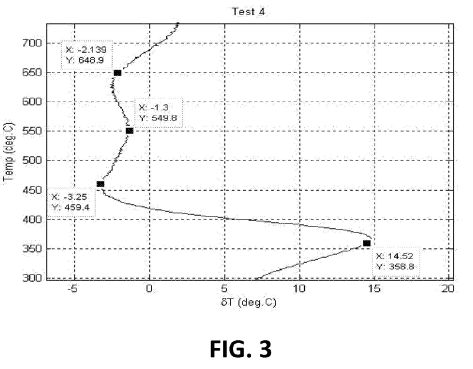
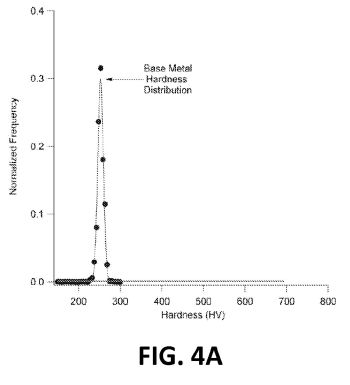
The invention discloses methods and apparatuses for rapid heating (e.g., induction coils) and immediate quenching (water, oil, air knives, molten salts, etc.) of low-, medium-, or high-carbon iron alloys such as AISI 4130. By heating the material to a selected temperature above its austenite conversion point and then quenching at an extremely fast rate, the alloy undergoes two distinct transformations: first to nano-scale bainite platelets and then to martensite or retained austenite, depending on quench temperature control. Experimental data show Vickers hardness peaks of ~525 and ~625, and differential thermal analysis confirms two transformation temperature ranges (650 deg C->550 deg C and 470 deg C->360 deg C). The process can be applied to sheets, strips, bars, tubes, and other workpieces, and can be integrated with single-head heating coils that treat multiple pieces simultaneously.
Principles
- Rapid austenitization
- Ultra-fast quenching
- Phase transformation control (bainite, martensite, retained austenite)
- Carbon segregation during short thermal cycles
Scientific Domains
Materials
- Low-carbon steel
- Medium-carbon steel
- High-carbon steel
- AISI 4130 alloy
- Molten salts (optional quench medium)
- Water
Mechanisms of Action
- Rapid heating raises alloy to austenite region
- Immediate quench freezes high-temperature microstructure
- Carbon-enriched zones transform to martensite, carbon-lean zones to bainite
- Controlled cooling can halt secondary transformations
Energy Sources
Applications
- Automotive frames and panels
- Aerospace structural components
- Lightweight armored vehicles
- High-performance consumer electronics chassis
Claimed Performance
Approximately 7 % higher strength than conventional steels, Vickers hardness peaks of ~525 and ~625, processing time <10 seconds, lower energy consumption and cost versus traditional heat-treatment.
Experimental Evidence
Flash processing of AISI 4130 yielded multiple hardness peaks of approximately 525 and 625 Vickers hardness; differential thermal analysis showed two transformation temperature ranges (650 deg C->550 deg C and 470 deg C->360 deg C) during a single quenching operation.
Replication Status
Demonstrated in laboratory settings (Ohio State University engineers and patent filings).
Limitations
- Requires specialized rapid-heating equipment (high-power induction coils)
- Process control is critical to achieve desired phase balance
- May be limited to certain alloy compositions
- Scale-up to large continuous sheets may present engineering challenges
Red Flags
- Need for high-rate heating equipment may increase capital expense
- Potential for uneven heating on complex geometries