Goal
Provide a flexible, concrete-impregnated fabric that hardens on hydration to create thin, durable, waterproof and fire-resistant concrete structures without the need for traditional mixing plant, enabling rapid deployment of shelters and civil-infrastructure elements.
Problem
Slow, labor-intensive conventional concrete construction; need for heavy mixing equipment; high environmental impact of cement works; lack of quick-deployable hardened shelters for emergency or temporary operations.
Concept Summary
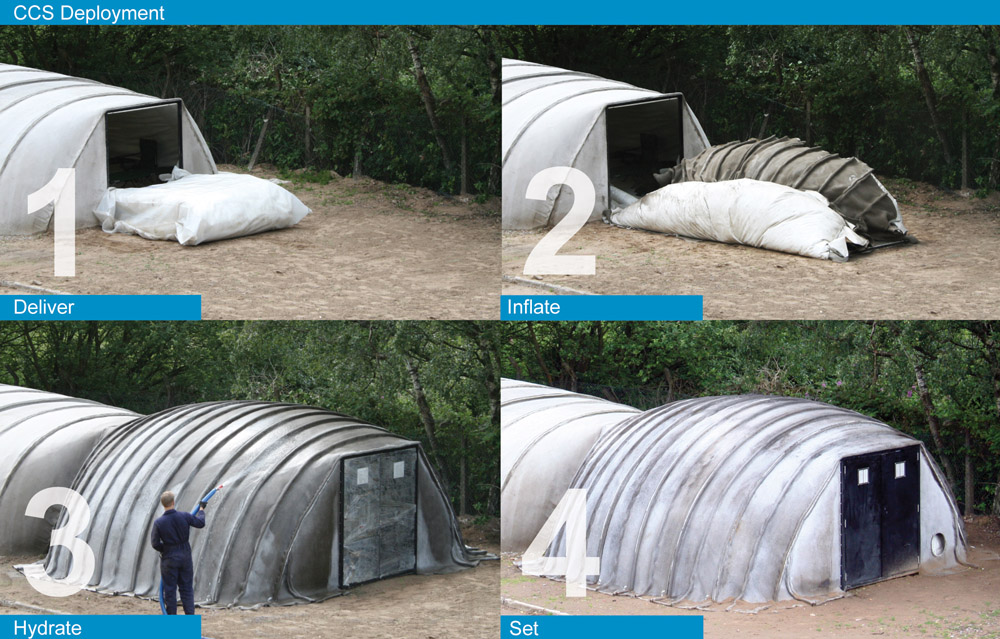
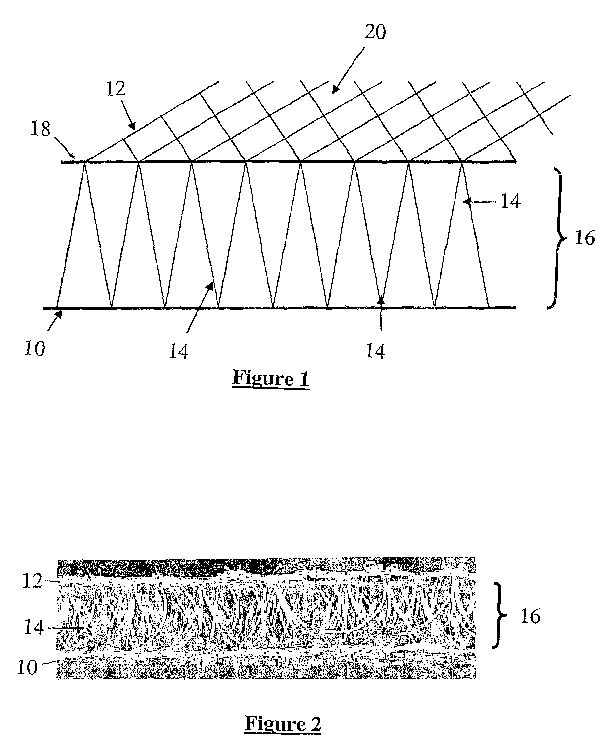
Concrete Canvas (CC) is a 3-dimensional spacer-fabric matrix containing a dry cement-based powder. When water is added (by spraying, immersion, or capillary action) the powder hydrates and sets, turning the flexible fabric into a rigid concrete panel. A PVC backing provides waterproofing. The system can be formed into shelters (CCS) by inflating a lightweight inner membrane, then hydrating the outer fabric to create a hardened, load-bearing shell.
Principles
- Fiber reinforcement
- Hydration curing of cement
- Spacer-fabric architecture
- Inflation-shaped thin-walled structures
- Waterproof PVC backing
Scientific Domains
Materials
- Cement
- Sand
- Fine aggregates
- Plasticizers
- PVC
- Polypropylene
- Coated glass fibres
- Nomex
- Kevlar
- Polyester
- Polyamide
- Microfibre
Mechanisms of Action
- Water penetrates powder particles -> cement hydration -> rigid concrete formation
- Pile yarns maintain spacing and provide reinforcement
- Inflation creates a pre-stressed shape that distributes compressive loads
- Capillary action and porous faces enable rapid liquid distribution
Applications
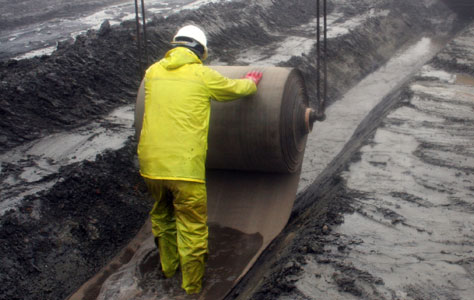
- Ditch lining
- Slope protection
- Secondary containment bunds
- Emergency shelters
- Medical field structures
- Flood defences
Claimed Performance
Installation is faster, easier and more cost-effective than traditional concrete; environmental impact of concreting reduced by up to 95 %; shelters have a design life >10 years and are hardened from day one of deployment.
Limitations
- Requires water for setting
- Limited to thin panel thicknesses (5-13 mm)
- Performance depends on proper hydration conditions