Goal
Provide a lightweight, battery-powered thrust unit for personal sports (paragliding, surfing, skiing, snowboarding, etc.) that replaces bulky gasoline engines.
Problem
Current powered-sport equipment relies on heavy, noisy, and potentially dangerous combustion engines; users need a compact, low-maintenance, instant-thrust solution.
Concept Summary
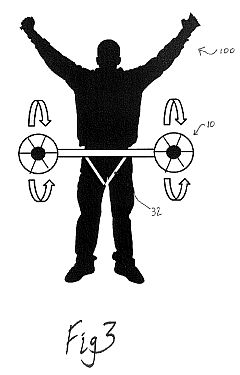
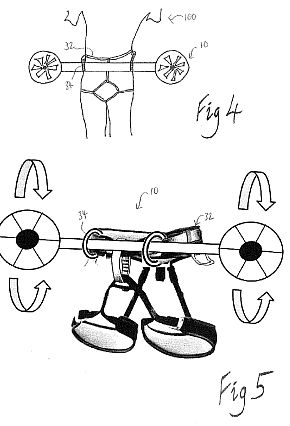
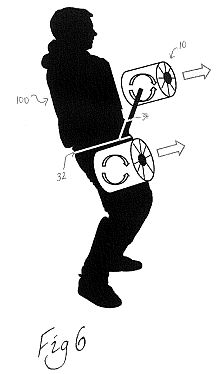
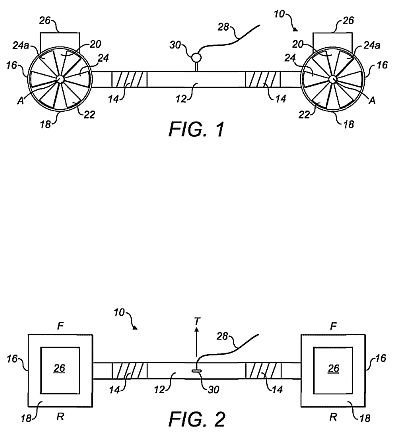
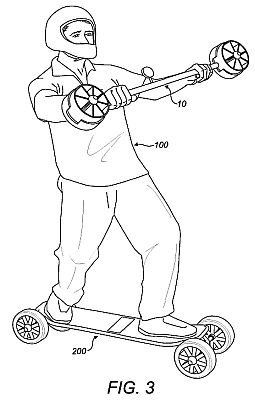
A high-rpm electric motor drives a fan/propeller housed in a lightweight carbon-fiber/aluminum frame. Power is supplied by a lithium-polymer battery pack. The unit is mounted on a harness and controlled by a thumb throttle or bite switch, delivering up to ~30 kg (~=70 lb) of thrust for a few minutes.
Detailed Description
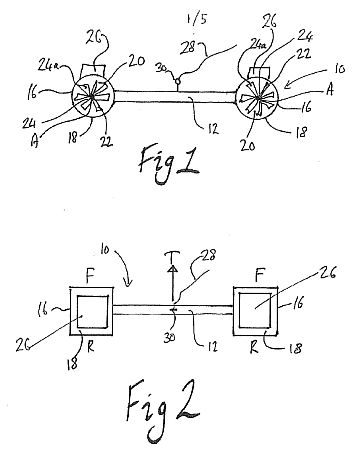
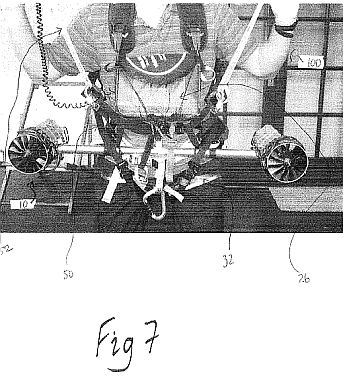
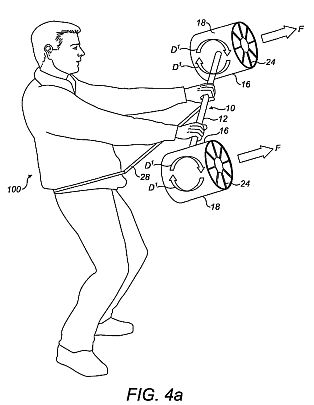
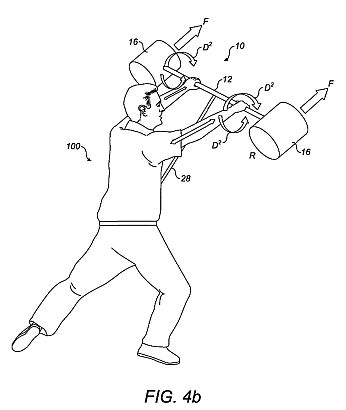
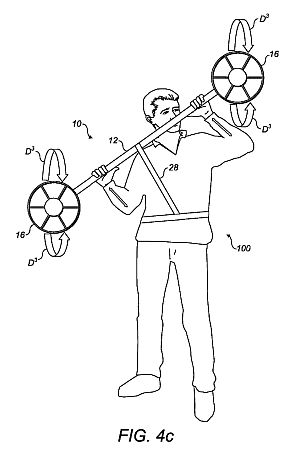
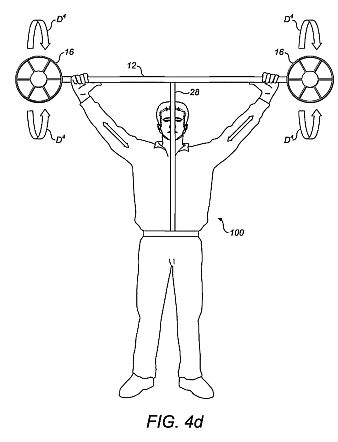
The DreamScience thruster uses multiple 8-kW electric motors running at ~30 000 rpm to spin carbon-fiber fans. The motors are powered by a high-current (~=700 A at 55 V) lithium-polymer battery. The thrusters are attached to a rigid bar or harness that sits against the front of the user's body. Control electronics allow speed and thrust-angle adjustment. Prototype weights are 8-12 kg with thrust ranging from 25 kg to 40 kg, providing 5-15 minutes of run-time at full power.
Principles
- Electric motor driving a high-rpm fan
- Air-moving thrust generation
- Coanda effect shrouds for thrust efficiency
- Battery-powered electric propulsion
Scientific Domains
Materials
- Carbon fiber
- Aluminum
- Lithium-polymer (Li-Po) battery cells
- Plastic composite
- Rubber (high-friction grip material)
Mechanisms of Action
- Electric motor converts electrical energy to rotational motion
- Fan accelerates air rear creating reaction thrust
- Coanda-effect shrouds shape airflow to increase thrust
- Battery supplies high-current DC power
Energy Sources
Applications
- Personal sport propulsion
- Paragliding
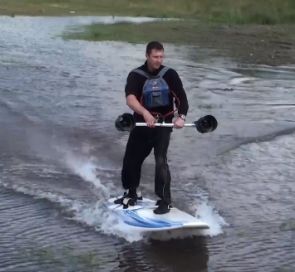
- Surfing
- Skiing
- Snowboarding
- Land-board / kite-replacement
Claimed Performance
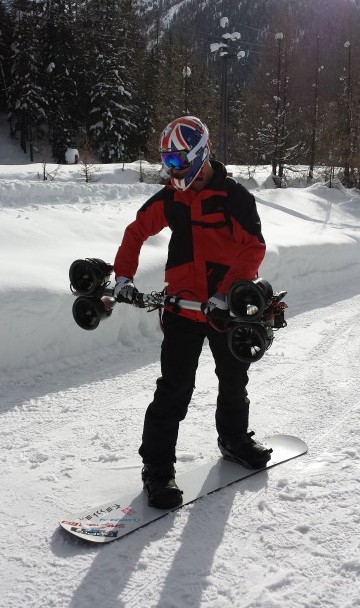
Four 8-kW thrusters produce >100 lb (~=445 N) total thrust; 8 kg unit delivers 25 kg thrust for 5 min, 40 kg thrust for 15 min; demonstrated 50 mph (80 km/h) speed on a snowboard.
Experimental Evidence
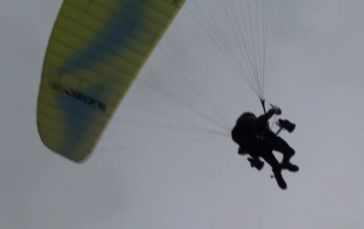
Prototype tested by snowboarder Jamie Barrow achieving 50 mph; video demonstration; paragliding test with 25 kg thrust; specifications listed in patent US2013161451.
Replication Status
Prototype tested by individual athletes; no independent third-party replication reported.
Limitations
- Short runtime (5-15 min at full power)
- Battery weight and high current demand
- Limited thrust relative to total system weight
- Requires further safety and control validation