Goal
Provide a cheaper, higher-mileage internal-combustion engine fuel that is non-explosive and can be used without engine modification.
Problem
Reliance on expensive gasoline and the need for more efficient, safer automotive and aviation fuels.
Concept Summary
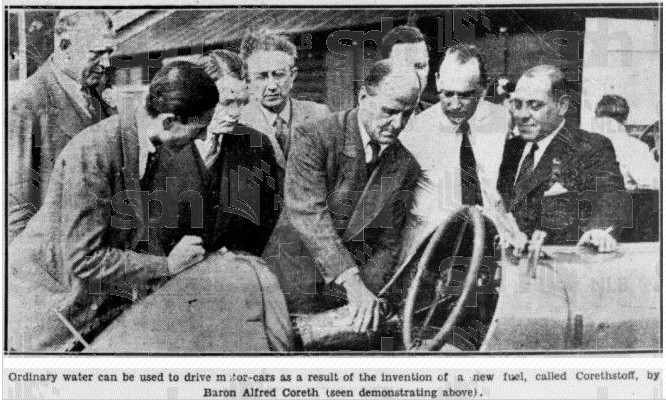
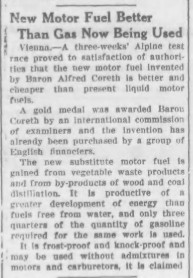
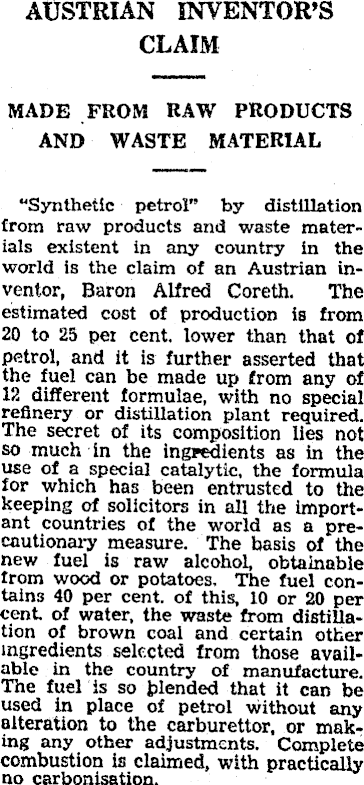
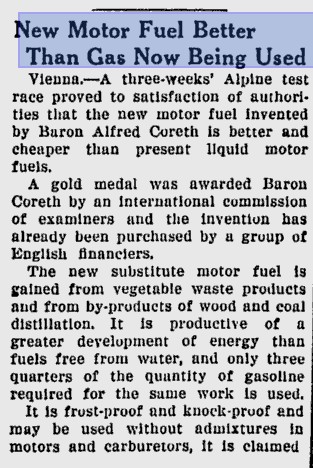
Corethstoff is a fuel mixture consisting mainly of water, raw (crude) alcohol, and a hydrocarbon carrier such as benzene, wood oil, or paraffin oil. The mixture contains at least 10 % water, which is absorbed by the alcohol and oil components. The resulting blend can be poured into any internal-combustion engine, delivering comparable power to gasoline while claiming 20 % greater range, reduced knocking, lower combustion temperature, and non-explosive properties.
Detailed Description
The invention builds on known alcohol-benzene-water mixtures but increases the water content by using impure crude alcohol (containing empyreumatic oil) and wood-spirit oils that promote water absorption. Various formulations are described, e.g., 40-45 % crude benzole, 40-45 % crude alcohol (85 deg C), and 10-20 % water, or alternatives replacing benzene with wood oil, tung oil, or paraffin oil. The fuel is claimed to keep engine cylinders free of carbon deposits, run without knocking, emit odorless exhaust, and provide at least the same power as gasoline while consuming less heat.
Principles
- Solvent-mediated water absorption in alcohol-oil mixtures
- Low-temperature combustion
- Knock suppression by water content
Scientific Domains
Materials
- Water
- Crude alcohol (~=85 % ethanol)
- Benzene
- Wood oil / wood-spirit oil
- Tung oil
- Paraffin oil
- Crude benzole
Mechanisms of Action
- Water dilutes the fuel, reducing peak combustion temperature
- Alcohol provides combustible energy
- Hydrocarbon carrier (benzene, wood oil, etc.) dissolves water and alcohol
Energy Sources
Applications
- Automobile fuel
- Aircraft fuel
Claimed Performance
20 % greater mileage than gasoline; non-explosive and practically non-inflammable; engines run without knocking; cylinders remain free of carbon deposits; low combustion heat; odorless exhaust.
Experimental Evidence
The article reports that the fuel "passes tests" and that "the cylinders of internal combustion engines is not calaminent; combustion takes place with a very low heat while providing at least as much power as when burning gasoline; engines are running, whatever happens, without knocking and exhaust gas has no odor."
Limitations
- Water content limited by solubility; excessive water may cause engine issues
- Performance claims lack independent, quantitative testing
- Potential for corrosion or material compatibility problems in long-term use
Red Flags
- Reliance on anecdotal newspaper reports rather than peer-reviewed data
- No independent replication or modern testing documented
- Claims of "20 % farther" mileage without quantitative methodology