Goal
Increase fuel efficiency and reduce pollutant emissions by burning a fine water-in-oil emulsion.
Problem
Air pollution from NOx and inefficient combustion due to nitrogen in air; high fuel consumption.
Concept Summary
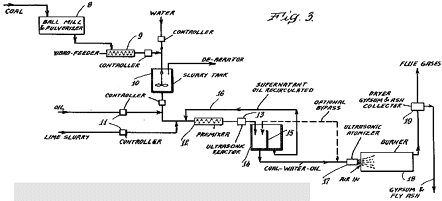
An ultrasonic reactor creates an extremely fine emulsion of water droplets (~=0.001 in) dispersed in hydrocarbon fuel (~=70 % fuel, 30 % water). When the emulsion is combusted, the water droplets rapidly vaporize and explode into steam, shattering the fuel into finer droplets, increasing surface area, and allowing combustion with much less air (and thus less nitrogen). This results in higher thermal efficiency, lower NOx and soot, and reported fuel-economy gains such as double miles-per-gallon in cars and 25 % fuel savings in heating applications.
Detailed Description
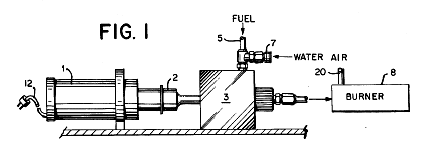
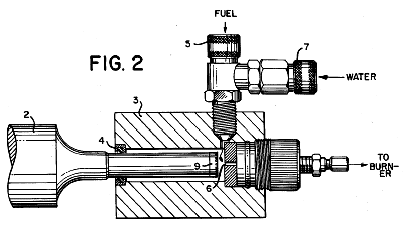
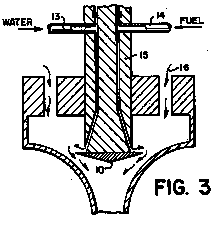
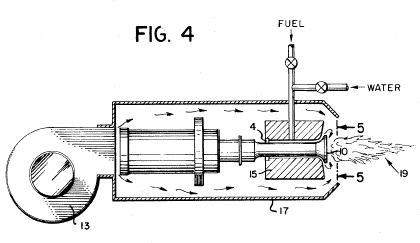
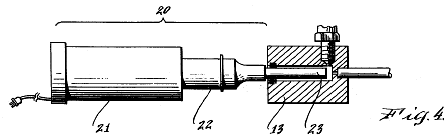
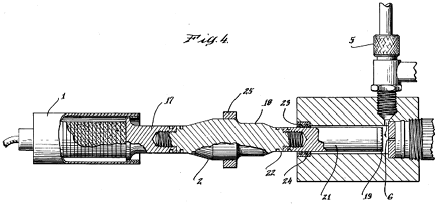
The invention employs an ultrasonic probe (~=20 kHz) that vibrates a crystal stack, acting as a 'super-blender' to break water into microscopic droplets and disperse them uniformly in oil or gasoline. The resulting emulsion can be generated on-the-fly in a carburetor or pre-formed and pumped to a burner. In combustion, the tiny water droplets absorb heat, expand, and explosively convert to steam, which atomizes the surrounding fuel further. This fine atomization promotes more complete combustion, reduces peak flame temperature (lowering NOx formation), and allows a 30 % water content without loss of heat output. The system can be applied to internal combustion engines, oil burners, and large furnaces, and does not require additional chemical emulsifiers, though small amounts of dialkyl sulfosuccinate may be used if desired.
Principles
- Ultrasonic agitation
- Emulsification
- Steam explosion
- Enhanced fuel atomization
Scientific Domains
Materials
- Hydrocarbon fuel (oil, gasoline, heavy fuel oil)
- Water
- Dialkyl sulfosuccinate (optional emulsifier)
Mechanisms of Action
- Fine water droplets vaporize explosively, increasing fuel surface area
- Reduced nitrogen intake by replacing air with water
- Lower peak flame temperature reduces NOx formation
Energy Sources
Applications
- Automotive engines
- Residential oil burners
- Industrial furnaces
- Heating plants for large buildings
Claimed Performance
Auto tests showed almost double MPG with negligible exhaust; school heating systems reduced fuel use by ~25 % and soot by 98 %; patents claim heat output comparable to 100 % oil despite 30 % water content.
Experimental Evidence
Newsweek reported double miles-per-gallon in a car with an ultrasonic reactor attached to the carburetor; Adelphi University saved >3,500 gal oil per week and reduced soot 98 %; Popular Mechanics cited "hundreds of tests" showing efficiencies close to 100 % in boilers.
Replication Status
Limited testing reported by the inventor and a few institutions; no independent peer-reviewed replication documented.
Limitations
- Requires ultrasonic reactor installation
- Control of water-fuel ratio and emulsion stability
- Potential cost of retrofitting existing equipment
Red Flags
- Claims of "almost double MPG" and "near-100 % efficiency" lack independent, peer-reviewed data
- Potential over-statement of performance without quantitative test results