Goal
Rapidly kill waterborne bacteria to provide safe drinking water.
Problem
Waterborne diseases (cholera, typhoid, hepatitis) and the need for low-cost, high-flow water purification in developing regions.
Concept Summary
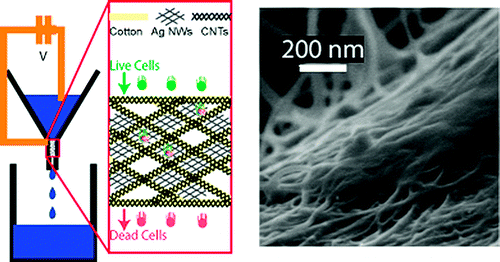
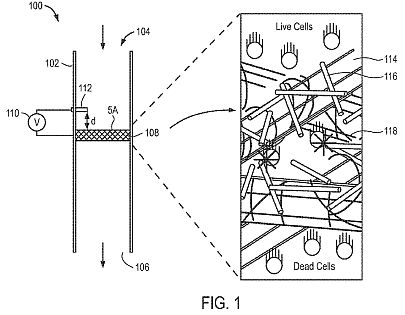
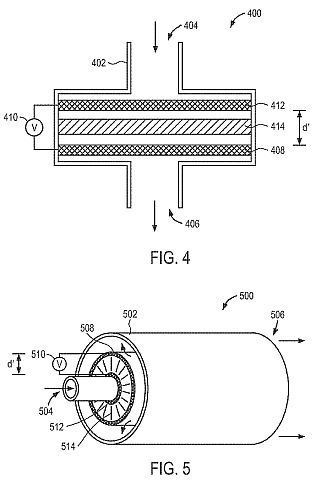
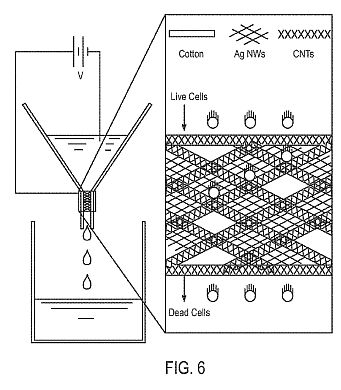
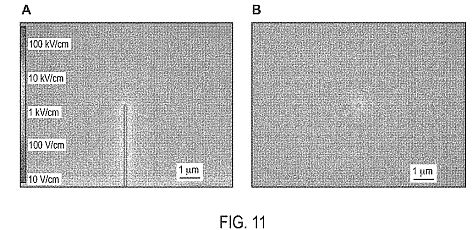
A cotton fabric is coated with silver nanowires and carbon nanotubes, creating a conductive nanostructured filter. When a modest electric voltage (~=20 V) is applied, an electric field and possible ions inactivate bacteria as water passes through the large-pore, gravity-fed filter, achieving >98 % kill in seconds without the pressure drop of membrane filters.
Detailed Description
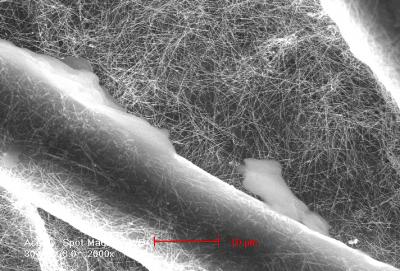
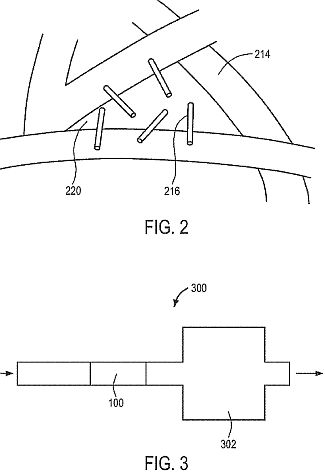
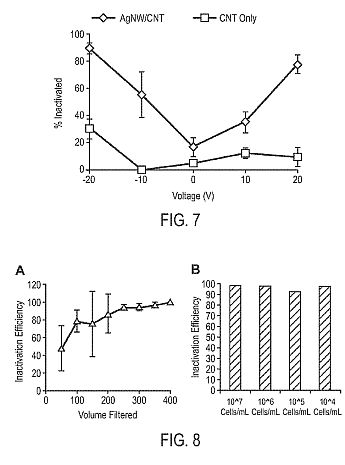
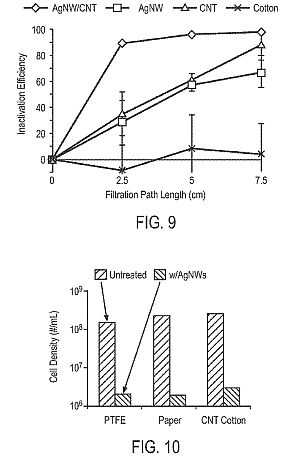
The filter is made by dipping ordinary woven cotton into a carbon-nanotube dispersion, drying, then dipping into a silver-nanowire solution (or a combined suspension). The nanowires (40-100 nm diameter, up to 10 um long) and nanotubes (few um long, ~1 nm wide) form a continuous conductive network on the fibers. An applied voltage creates a strong electric field at nanowire tips and a small current (few mA) that kills bacteria via electrical disruption and silver ion toxicity. The device operates by gravity, requiring no pumps, and can be powered by small solar panels, 12-V car batteries, hand-crank generators, or stationary bicycles. Laboratory tests showed >98 % inactivation of Escherichia coli within several seconds at 20 V, and a flow rate of ~100 000 L * h^-^1 * m^-^2, roughly 80 000x faster than conventional bacterial-trapping filters.
Principles
- Electrical field induced bacterial inactivation
- Silver ion antimicrobial activity
- High surface area nanostructure conductivity
- Gravity-fed fluid flow through large pores
Scientific Domains
Materials
- Silver nanowires
- Carbon nanotubes
- Cotton fabric
Mechanisms of Action
- Electric field killing
- Silver ion release
- Electrochemical pH alteration
- Rapid water flow through non-trapping pores
Energy Sources
Applications
- Drinking water purification in remote villages
- Emergency water treatment
- Industrial water sterilization
Claimed Performance
Over 98 % of E. coli killed in several seconds at 20 V; filter 80 000x faster than conventional bacterial-trapping filters; gravity-fed flow rate ~=100 000 L * h^-^1 * m^-^2; electricity consumption ~=1/5 of a comparable pump.
Experimental Evidence
Lab tests reported >98 % kill of E. coli after a few seconds at 20 V; gravity-fed device operating at 100 000 L * h^-^1 * m^-^2; performance data shown in Nano Letters 2010 (doi:10.1021/nl101944e).
Replication Status
No independent replication reported in the article; results are from the authors' laboratory tests.
Limitations
- Requires a modest electrical power source
- Effectiveness against a broad range of pathogens not fully demonstrated
- Potential silver nanoparticle release into water