Goal
Reduce indoor heating energy consumption by providing personal thermal management through passive infrared reflection and optional active Joule heating.
Problem
Large portion of global energy is spent on heating buildings; much of that heat is wasted on empty spaces and inanimate objects.
Concept Summary
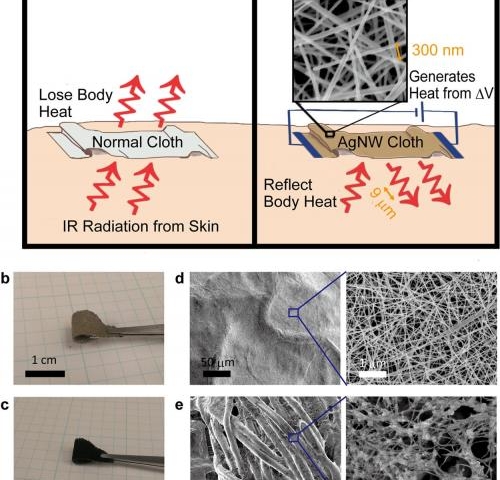
Clothing dip-coated with a silver nanowire (AgNW) solution creates a breathable, porous metallic mesh that reflects >90 % of a person's infrared body radiation, providing passive insulation, and can also be powered electrically to generate Joule heating at low voltage.
Detailed Description
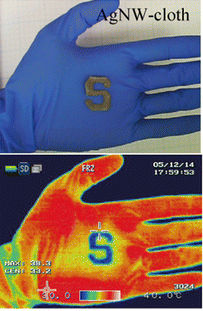
The researchers dip-coat cotton fabric in an aqueous AgNW dispersion, depositing ~0.1 g m^-^2 of nanowires (~=300 nm spacing). The metallic network behaves like a continuous low-emissivity film (epsilon~=0.02), reflecting most body-heat IR (~=9 um wavelength) while allowing water vapor to pass. When connected to a 0.9 V source, the cloth temperature rises to ~38 deg C (~=1 deg C above skin temperature). Calculations suggest a potential energy saving of ~8.5 kWh person^-^1 day^-^1 (~=1 000 kWh yr^-^1) compared with conventional indoor heating. Alternative metals (Cu, Ni, Al) could lower cost; carbon nanotube coatings were tested but showed poor IR reflectivity.
Principles
- Low emissivity metallic coating
- Infrared reflectance
- Joule heating
- Porous nanowire structure for breathability
Scientific Domains
Materials
- Silver nanowires
- Cotton textile
- Copper nanowires (alternative)
- Nickel nanowires (alternative)
- Aluminum nanowires (alternative)
- Carbon nanotubes (alternative)
Mechanisms of Action
- Reflection of body infrared radiation
- Electrical Joule heating when voltage applied
- Breathability via nanowire spacing
Energy Sources
Applications
- Personal heating apparel
- Energy-efficient indoor clothing
- Cold-weather outdoor gear
Claimed Performance
Reflects >90 % of body IR; Joule heating raises temperature to 38 deg C at 0.9 V; coating mass 0.1 g m^-^2; estimated energy saving up to 1 000 kWh yr^-^1 per person.
Experimental Evidence
Lab measurements showed >90 % IR reflectance and a 1 deg C temperature rise at 0.9 V; calculations based on average heating demand (367 W) vs. 12 W required by active AgNW clothing.
Replication Status
Only reported by the original research team; no independent replication documented in the article.
Limitations
- Cost of silver nanowires may be high for large-scale production
- Durability of coating after repeated washing not yet demonstrated
- Active heating limited to low power (~=12 W)
- Breathability may degrade if nanowire network clogs
Red Flags
- Energy-saving figures are based on calculations, not field trials
- Potential underestimation of material and manufacturing costs