Goal
Generate electrical power from an acoustic-stimulated permanent magnet without moving parts, improving the efficiency of permanent-magnet transformers.
Problem
Need for solid-state generators with no moving components and for higher efficiency in magnetic induction power conversion.
Concept Summary
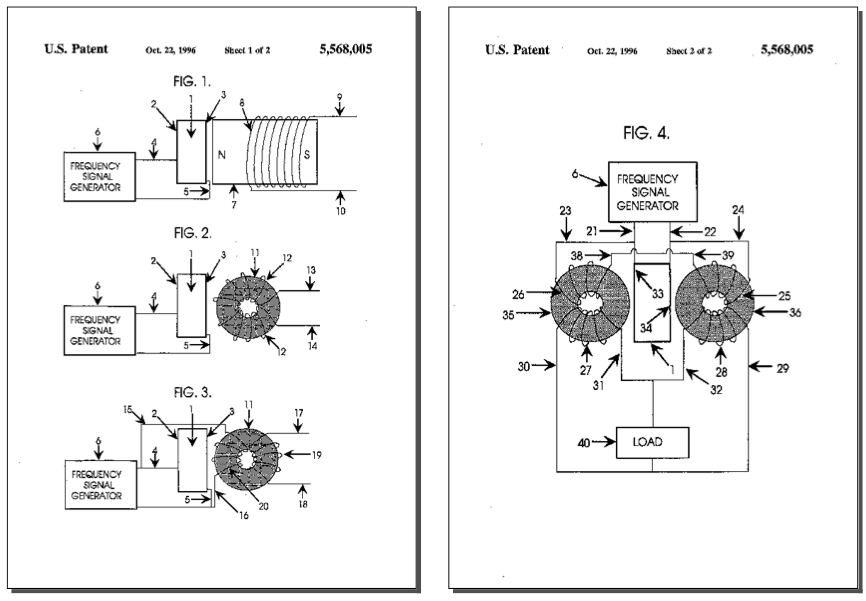
An acoustic field produced by a piezoelectric transducer is directed at a permanent magnet, stimulating the nuclear/electronic structure of the magnet and causing its magnetic field to oscillate. A coil placed within this oscillating field induces an alternating electrical current, providing power generation.
Detailed Description
The invention uses a piezoelectric (or other) acoustic transducer driven by an alternating-signal generator. The acoustic waves impinge on a permanent-magnet core (bar-type or toroidal). The acoustic energy is claimed to stimulate the nuclear level of the magnetic material, causing the electronic structure-and thus the magnetic field-to vibrate. A pickup coil located inside the magnet's field captures the induced voltage. By combining the acoustic stimulation with a conventional stimulating coil, the efficiency of the permanent-magnet transformer is increased. The patent illustrates two embodiments: (1) a bar magnet with a surrounding coil, and (2) a toroidal magnet with a coil wrapped around it.
Principles
- Acoustic stimulation of solid nuclei
- Piezoelectric conversion of electrical signal to acoustic wave
- Magnetostrictive-like nuclear vibration
- Electromagnetic induction
Scientific Domains
Materials
- Permanent magnet (e.g., ferrite, neodymium)
- Piezoelectric transducer (e.g., quartz, PZT)
- Copper wire coil
- Acoustic transducer housing
Mechanisms of Action
- Acoustic wave induces nuclear vibration in permanent magnet
- Vibrated electronic structure oscillates magnetic field
- Changing magnetic flux induces voltage in surrounding coil
Energy Sources
Applications
- Low-power electricity generation
- Portable power supplies
- Alternative energy research
Claimed Performance
Increased efficiency of permanent-magnet induction transformers; no quantitative power or efficiency figures are provided.
Experimental Evidence
The patent description states that the acoustic field enhances the stimulating effect on the permanent magnet, but no measured data, graphs, or independent test results are presented.
Limitations
- No quantitative performance data
- No independent replication reported
- Potentially low power output compared to conventional generators
Red Flags
- Free-energy / over-unity claims without peer-reviewed data
- Lack of independent verification
- Potential for marketing hype