Goal
Provide an aircraft with extremely high maneuverability, vertical take-off and landing, hover capability, compact dimensions and fuel economy.
Problem
Complexity, high fuel consumption and limited maneuverability of conventional helicopters and VTOL aircraft.
Concept Summary
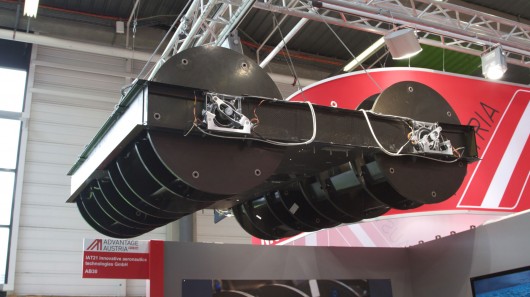
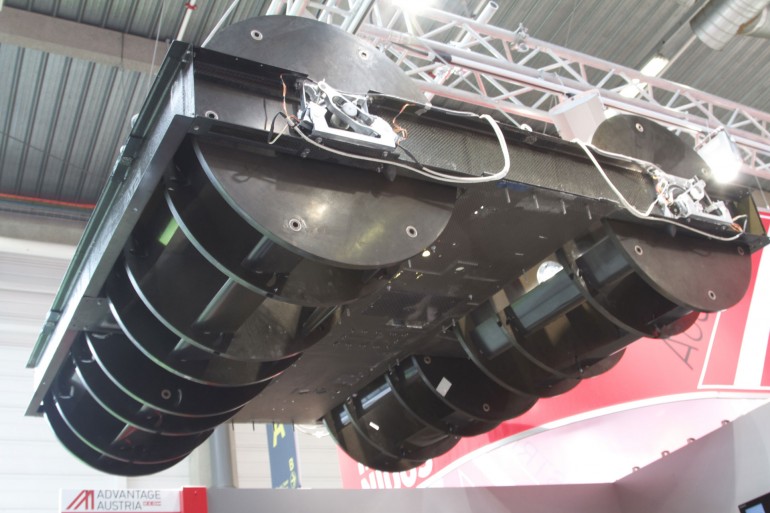
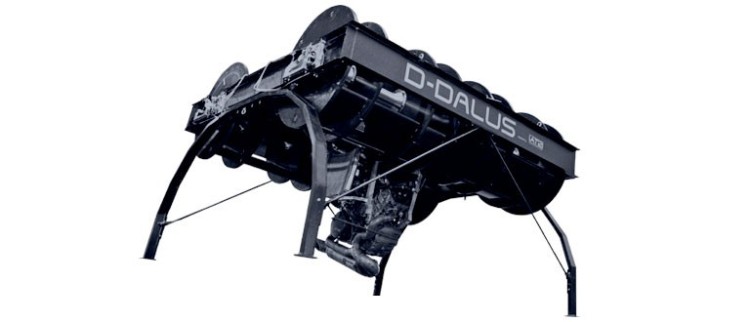
A UAV/VTOL aircraft that uses four contra-rotating cylindrical turbine pods. Each pod contains a set of blades whose pitch can be varied by offsetting the pod axis, allowing thrust to be vector-controlled in any direction. A friction-free pivot bearing and gyroscopic neutralisation give stability, enabling vertical launch, hover, omnidirectional flight and precise payload handling.
Detailed Description
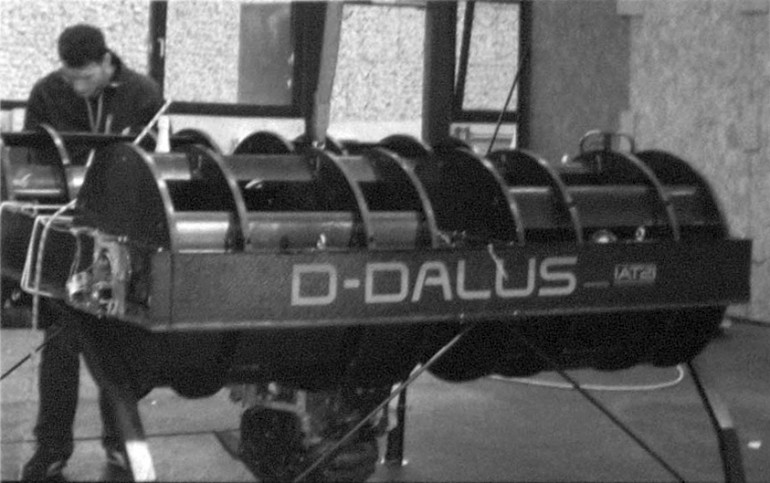
The D-Dalus has a square frame with four turbine pods at the corners. Each pod houses a pair of contra-rotating disks driven by a conventional aero-engine (~=120 bhp, 2 200 rpm). Blade-pitch mechanisms inside the disks can be offset, changing the angle of attack of individual blades and thus directing thrust vectorially around a full 360 deg . The system includes a virtually frictionless pivot bearing at high-G points and a dynamic-equilibrium control system for rapid stability restoration. A prototype has demonstrated vertical take-off, hover, transition to forward flight and a payload capacity of roughly 150 lb.
Principles
- Contra-rotating cylindrical rotors
- Variable blade pitch (thrust vectoring)
- Frictionless pivot bearing
- Gyroscopic neutralisation
Scientific Domains
Mechanisms of Action
- Thrust vectoring via blade pitch control
- Gyroscopic stabilisation from contra-rotating rotors
- Friction-free pivot bearing reducing mechanical losses
Energy Sources
Applications
- Search and rescue
- Disaster monitoring
- Surveillance
- Autonomous pallet transport
- Future passenger VTOL
Claimed Performance
Four turbines at 2 200 rpm, payload capability ~150 lb, vertical take-off, hover, 360 deg thrust vectoring, near-silent operation.
Experimental Evidence
Prototype tested successfully; vertical to forward flight transition demonstrated in a laboratory near Salzburg; payload of about 150 lb lifted; flight characteristics shown at the Paris Air Show (2011).
Replication Status
Prototype tested; no independent replication reported.
Limitations
- Complex mechanical pitch-control system
- Reliance on conventional internal-combustion engine
- Limited payload compared with larger helicopters
- No independent verification of performance
Red Flags
- Claims of near-silent operation and "almost maintenance-free" not quantified
- Potential over-statement of maneuverability without peer-reviewed data