Goal
Provide reactionless thrust for propulsion without expelling reaction mass.
Problem
Need for a propulsion system that does not require propellant or reaction mass, potentially enabling new vehicle designs.
Concept Summary
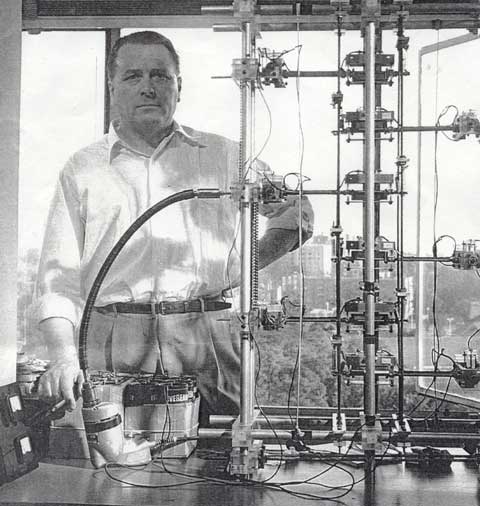
The Dean Drive is claimed to generate unidirectional thrust using asymmetrically rotating masses and vibration, allegedly exploiting a "fourth law of motion" that provides reactionless propulsion. Demonstrations reported only apparent weight reduction on a scale, but no reproducible data exist.
Detailed Description
According to the patents and anecdotal reports, the device contains rotating weights that are driven asymmetrically, producing vibration and an alleged net thrust without external reaction mass. The inventor asserted that this effect stemmed from a nonlinear correction to Newton's laws, sometimes described as a fourth law of motion. Skeptics attribute the observed scale readings to vibration-induced friction, resonance, or outright deception. No independent replication or peer-reviewed validation has been documented.
Principles
- asymmetrical rotating masses
- vibration-induced thrust
- nonlinear correction to Newtonian motion (fourth law of motion)
Scientific Domains
Materials
- metal rotating weights
Mechanisms of Action
- reactionless thrust via asymmetric inertia
- momentum transfer through vibration and resonance
Energy Sources
Applications
- submarine propulsion
- spacecraft thrust
- any vehicle requiring reactionless thrust
Claimed Performance
Reported reduction in scale weight when the device is activated; no quantitative thrust values provided.
Experimental Evidence
John W. Campbell claimed to have observed the device reducing the weight reading on a bathroom scale during activation.
Replication Status
No independent replication or verified demonstration reported.
Limitations
- Violates established Newtonian physics
- No reproducible experimental data
- Potential for deceptive demonstration
- Lack of peer-reviewed validation
Red Flags
- Absence of quantitative performance data
- Claims rely on anecdotal observations
- No independent verification or replication
- Potential conflict with fundamental physics