Goal
Split water using sunlight to produce hydrogen and oxygen with reversible gas storage
Problem
Need for efficient, inexpensive solar-driven water splitting and clean gas separation
Concept Summary
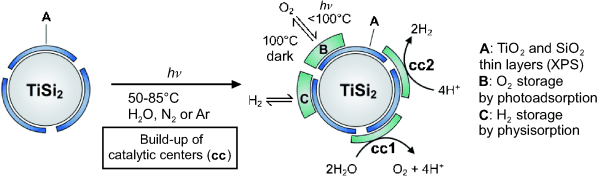
Titanium disilicide (TiSi2) acts as a visible-light-absorbing semiconductor photocatalyst that splits water into H_2 and O_2 while simultaneously physisorbing the gases, allowing low-temperature release of hydrogen and higher-temperature release of oxygen for easy separation.
Principles
- photoelectrochemical water splitting
- semiconductor bandgap absorption
- reversible physisorption of gases
- solar-driven catalysis
Scientific Domains
Materials
- titanium disilicide (TiSi2)
- silicon
- titanium oxide (surface oxide layer)
- perylene dyes (optional light-absorbing enhancers)
Mechanisms of Action
- photocatalytic oxidation/reduction of water
- charge separation in TiSi2 under illumination
- surface adsorption of H_2 and O_2
- thermal desorption of stored gases
Energy Sources
Applications
- renewable hydrogen generation
- solar-driven chemical production
- clean gas separation technologies
Claimed Performance
Higher efficiency than most visible-light semiconductor photocatalysts; hydrogen desorbs at ambient temperature, oxygen released above ~100 deg C in darkness.
Experimental Evidence
Demonstrated water splitting and reversible gas storage using TiSi_2 in laboratory experiments reported in Angewandte Chemie (2007).
Replication Status
No independent replication reported; technology remains at laboratory-scale.
Limitations
- Limited gas storage capacity of TiSi_2
- O_2 release requires >100 deg C and darkness
- Long-term stability and scalability not demonstrated