Goal
Generate electrical energy directly from space (free energy) to address global energy and environmental crises.
Problem
World energy shortage and reliance on conventional energy sources.
Concept Summary
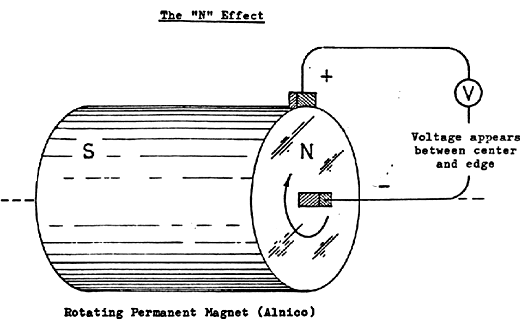
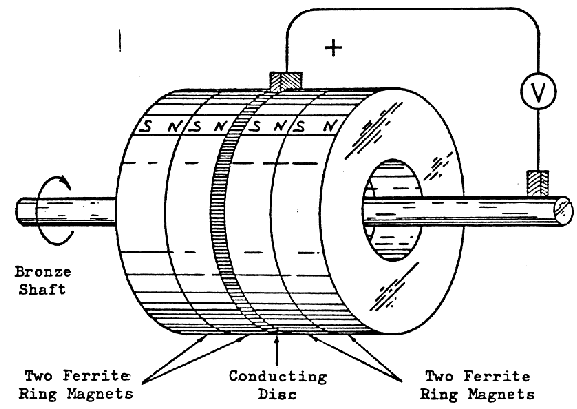
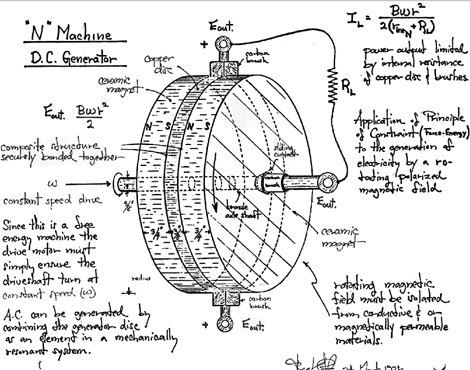
The N-Machine combines inertial mass polarization of a rotating object with magnetic polarization of a magnetized conductor. A rotating cylindrical magnet (or ferrite ring magnets) with a conducting disc creates a symmetric electric field inside the magnet. Electrical current is extracted via contacts on the axis and rim. The device claims to produce electrical power without the usual mechanical drag of conventional generators, potentially yielding over-unity output.
Detailed Description
The N-Machine is built from a copper or bronze shaft and disc, with ferrite ring magnets or alnico magnets cemented on either side. In a typical prototype using ordinary loudspeaker ring magnets (~=1000 gauss), rotation at 3450 rpm produced about 30 mV and up to 30 A (~=0.9 W). The voltage scales with speed, magnetic field strength, and the square of the machine radius. The author argues that the rotating magnet's inertial mass becomes anisotropic, allowing extraction of energy from a "fine substance" that pervades space. The device is described as non-reciprocal: loading does not produce motor drag because the torque is confined within the machine. Future work envisions high-current low-voltage operation, self-sustaining systems coupling the N-generator with a Faraday motor, and scaling to practical power levels.
Principles
- Faraday unipolar dynamo
- Inertial mass polarization
- Magnetic polarization
- Centrifugal extraction of space energy
- Non-reciprocal torque confinement
Scientific Domains
Materials
- copper
- bronze
- ferrite
- alnico
- epoxy cement
- loudspeaker ring magnets
Mechanisms of Action
- Rotating magnetized conductor creates a cylindrically symmetric electric field
- Inertial mass anisotropy of a rotating body polarizes the mass
- Electrical current is drawn via axis and rim contacts
- Torque generated by load is trapped within the cemented magnet-disc assembly
Energy Sources
Applications
- alternative energy generation
- high-current low-voltage power supplies
- self-sustaining electric drives
Claimed Performance
Prototype delivers 30 mV at 3450 rpm with up to 30 A current; author claims up to five times the input energy (over-unity) and the ability to generate hundreds of volts at thousands of amperes when scaled.
Experimental Evidence
A single test in an Auckland workshop measured electrical output but failed to demonstrate over-unity; most of the output energy was lost as heat.
Replication Status
Only one documented test; no independent replication reported.
Limitations
- Very low voltage output in prototype
- Significant heat loss
- No demonstrated over-unity in independent tests
- Requires precise mechanical construction and high-speed rotation
Red Flags
- Claims contradict established physics
- Lack of peer-reviewed data or independent replication
- Potential for fraud or misinterpretation of measurements