Goal
To visually demonstrate how economic forces interact and cause prosperity or depression by using a hydraulic analog model.
Problem
The difficulty of intuitively understanding and communicating the complex relationships among labor, capital, debt, resources, and other economic factors.
Concept Summary
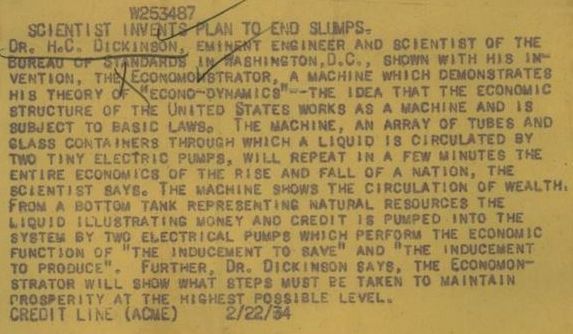
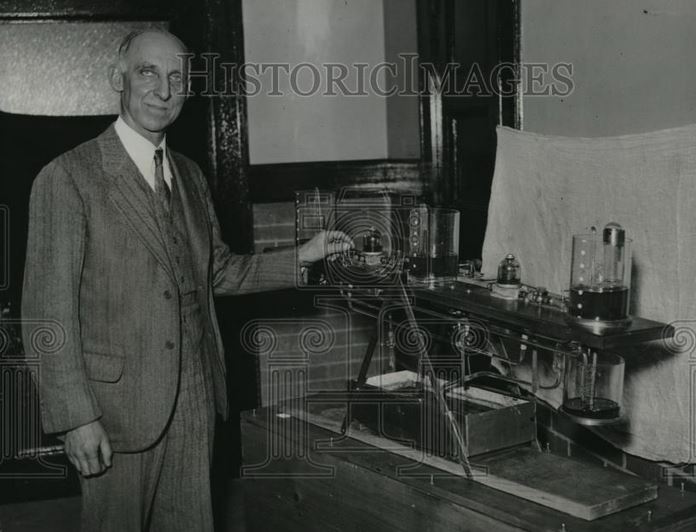
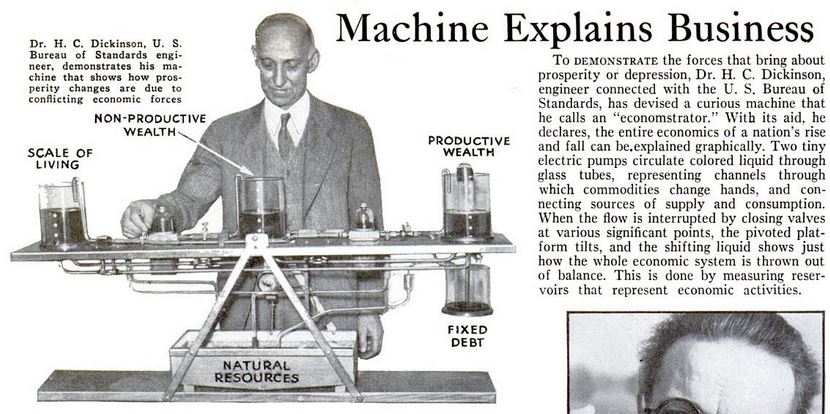
A tabletop hydraulic system in which colored water (representing money) circulates through glass tubes and reservoirs that model five economic factors. Two electric pumps drive the flow; valves open and close to simulate changes in supply and demand. The fluid levels cause a pivoted platform to tilt, providing a visual illustration of economic imbalance.
Detailed Description
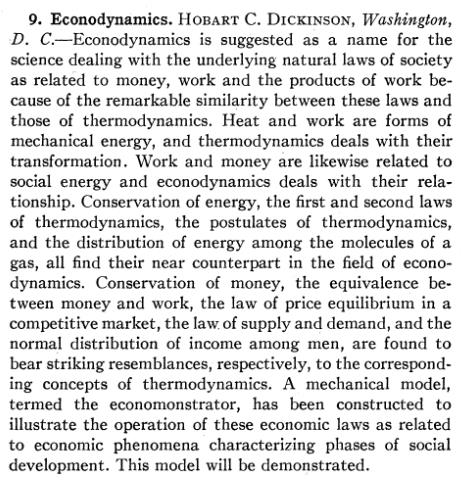
The Economonstrator consists of a set of glass tubes and reservoirs representing (1) products of labor, (2) personal property, (3) capital goods, (4) debts, and (5) natural resources. Dyed water is pumped by two small electric pumps through the network. By opening or closing valves at key points, the operator can simulate a "sample depression" or boom, causing the liquid to shift among the tanks. The tanks sit on a see-saw-like platform that tilts when the hydraulic balance is disturbed, making the over- or under-activity of each factor visible. The device was demonstrated in Popular Science (May 1934) and other periodicals, with photographs showing the flowing liquid and the tilting platform.
Principles
- Hydraulic analogies
- Fluid dynamics
- Balance and torque
- Visual representation of abstract concepts
Scientific Domains
Materials
- Dyed water (colored liquid)
- Glass tubes
- Metal or wooden reservoirs
- Electric pumps
- Valves
- Pivoted platform (likely wood/metal)
Mechanisms of Action
- Pressure-driven liquid flow
- Valve control of flow pathways
- Torque generated by unequal fluid levels causing platform tilt
Energy Sources
Applications
- Educational tool for economics
- Public outreach and demonstration of macro-economic concepts
- Historical illustration of analog modeling techniques
Claimed Performance
The machine can instantly show over-prosperity, excessive debt, speculation, and other economic states by the way the liquid shifts and the platform tilts.
Experimental Evidence
Demonstrated in public exhibitions and photographed for Popular Science (May 1934), Scientific American, and several newspaper articles; described in multiple contemporary publications.
Replication Status
No documented independent replication; only the original inventor's demonstrations are reported.
Limitations
- Qualitative only; does not provide quantitative predictions
- Requires manual operation and interpretation
- Scale limited to tabletop demonstration
- Analogy may oversimplify complex economic dynamics