Confidence
0.90
Practicability
0.70
Evidence
0.20
Fringe Score
0.20
Risk
0.20
TRL
4
Goal
Replace observation balloons with a safer, more maneuverable, motor-driven aircraft for military observation.
Problem
Traditional kite-balloons and observation balloons are bulky, lack maneuverability, and pose safety risks to pilots.
Concept Summary
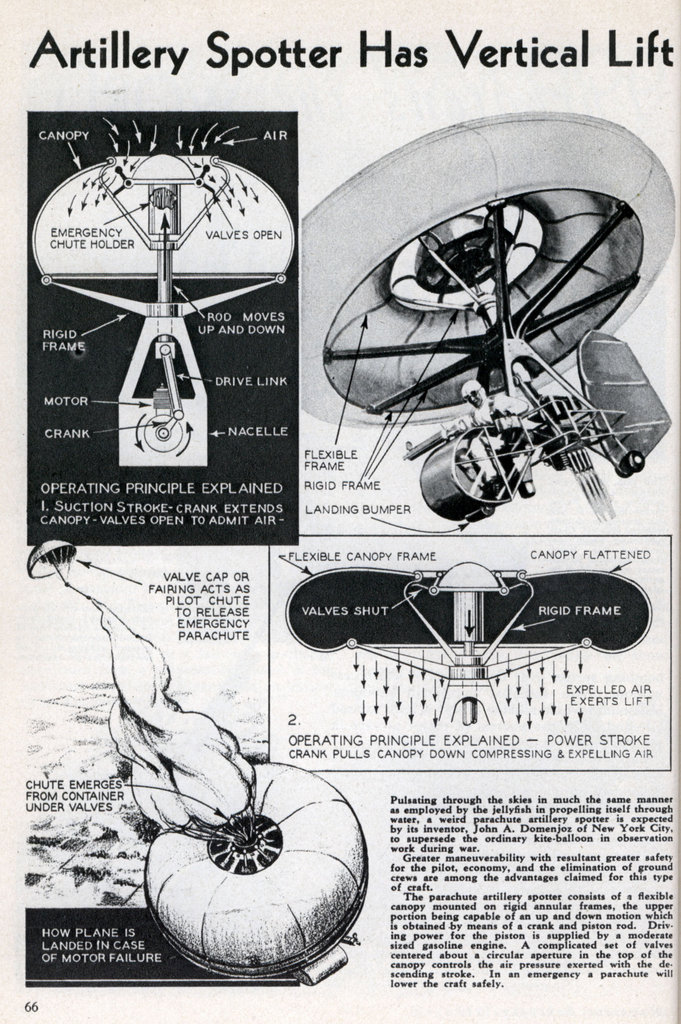
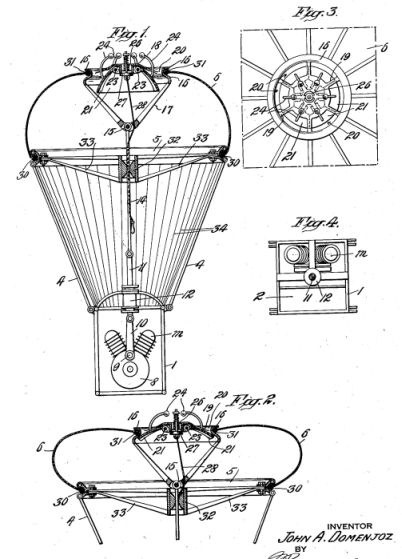
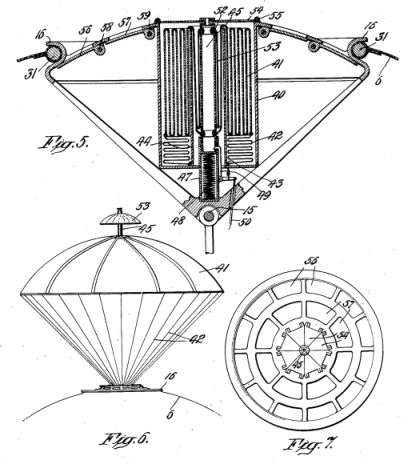
A flexible rubberized-canvas canopy is mounted on a rigid annular frame and driven up and down by a gasoline engine via a crank-and-piston mechanism. One-way shutters and a manual valve control airflow, creating lift through pressure differentials. A supplemental parachute provides emergency descent capability.
Principles
- Reciprocating motion of flexible canopy
- Pressure-differential lift
- One-way valve/shutter control
- Motor-driven piston action
Scientific Domains
Materials
- Rubberized canvas (fabric)
- Steel or aluminum frame
- Rubberized canvas canopy
Mechanisms of Action
- Vertical reciprocation of canopy creates suction above and pressure below, generating lift
- One-way shutters open on upward stroke to allow airflow and close on downward stroke to trap air
- Manual air valve permits rapid altitude changes
- Supplemental parachute ejects in engine failure for safe landing
Energy Sources
Applications
- Military reconnaissance
- Aerial surveillance
Claimed Performance
Greater maneuverability, improved pilot safety, economy of operation, and elimination of ground crews compared with conventional observation balloons.
Limitations
- Reliance on gasoline engine and fuel supply
- Complex valve and shutter mechanisms may be prone to failure
- Limited lift capacity compared with larger balloons
Red Flags
- No quantitative performance data provided
- No independent testing or replication reported