Goal
Provide a therapeutic magnetic field to treat cancer and improve overall health by aligning DNA polarization.
Problem
Cancer and other health disorders allegedly caused by imbalanced electromagnetic fields in the body.
Concept Summary
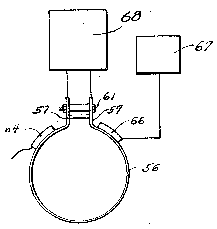
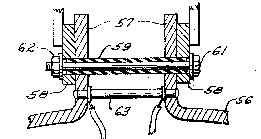
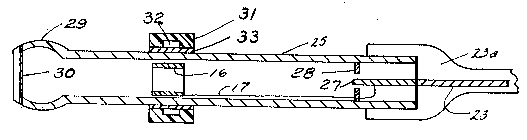
The Dotto Ring is a 27-inch copper torus with adjacent heated and refrigerated sections that create a thermal gradient. This gradient drives a combined Thompson-Peltier-Seebeck (thermionic) effect, generating a mild magnetic field that is claimed to align DNA polarization and produce therapeutic benefits, including cancer remission.
Detailed Description
The ring is made of heavy copper and incorporates a heating element on one side and a cooling element on the opposite side, establishing a temperature differential. According to Dotto, the resulting thermionic couple produces a magnetic field analogous to a transformer core, which interacts with the body's natural electromagnetic environment. Animal studies reported that mice injected with cancer cells survived significantly longer when placed within the ring's field, and human users reportedly experienced no side effects after several years of use in Dotto's Bio-Physics Laboratory.
Principles
- Thermionic emission
- Thompson-Peltier-Seebeck effect
- Magnetic field induction
- DNA polarization alignment
- Electromagnetic field therapy
Scientific Domains
Materials
- Copper
- Heating element (unspecified)
- Cooling element (unspecified)
- Insulation (unspecified)
Mechanisms of Action
- Thermal gradient creates an electromotive force
- Generated magnetic field influences cellular electromagnetic environment
- Alignment of DNA polarity and resonance
Energy Sources
Applications
- Cancer therapy
- General health enhancement
- Alternative electromagnetic medicine
Claimed Performance
Treated mice survived beyond 7 days (untreated died ~7 days) with no detectable cancer; human users reported uniform health benefits and no side effects over 5 years.
Experimental Evidence
Seven controlled mouse studies (C-27 cancer cells, Krib carcinoma, leukemia) performed by Prof. Gerald Willis and Dr. Robert Zipf showed survival of treated mice and absence of cancer at necropsy. No independent replication reported.
Replication Status
No independent replication; only internal studies described.
Limitations
- Lack of peer-reviewed data
- No independent replication
- Unclear physical mechanism
- Potential regulatory issues (FDA suppression claim)
Red Flags
- Extraordinary health claims without rigorous clinical trials
- Anecdotal evidence and suppression narrative
- No disclosed quantitative field measurements
- Potential conflict of interest (inventor also author of studies)