Goal
Reduce CO_2 emissions by up to 50 % by harvesting waste-heat from the exhaust and converting it into additional mechanical power for the engine.
Problem
Only ~20 % of the energy from fossil-fuel combustion is used for work; the remaining ~30 % is lost as low-grade waste heat, leading to higher fuel consumption and CO_2 emissions.
Concept Summary
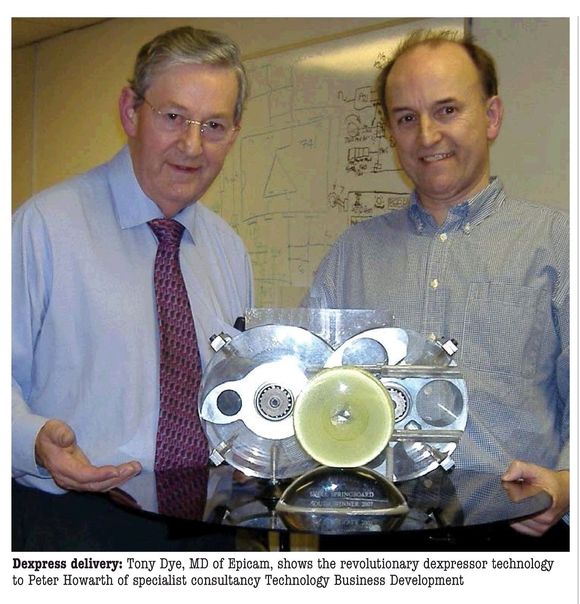
The Dexpressor captures exhaust-gas heat, transfers it to water in a heat-exchange coil around the exhaust manifold, raises the water to super-critical conditions (~370 deg C, 1000 bar), and uses the resulting high-pressure fluid to drive a pair of low-friction rotors. One rotor feeds torque to the engine crankshaft, effectively adding power and allowing a smaller engine size for the same output, thereby cutting fuel use and CO_2 emissions.
Detailed Description
A closed-loop system extracts low-grade heat from the exhaust, circulates water through a coil that becomes super-critical, and stores the pressure in a retention chamber. Two rotors, driven by the high-pressure fluid, convert this pressure into mechanical rotation. One rotor is mechanically linked to the engine crankshaft, providing additional torque. The system is intended to be compact enough for automotive integration and could also be applied to stationary power-plant engines.
Principles
- heat exchange
- supercritical water generation
- pressure retention
- rotary expansion
- thermodynamic cycle
Scientific Domains
Materials
- water
- metal heat-exchange coil
- exhaust manifold (metal)
- rotor components (metal alloys)
- high-strength pressure vessel
Mechanisms of Action
- collection of exhaust heat
- heating water in a coil
- creation of super-critical water at high pressure
- driving rotors via high-pressure fluid
- supplying additional torque to the engine crankshaft
Energy Sources
Applications
- automotive internal-combustion engines
- stationary power-plant engines
- any heat-generating engine system
Claimed Performance
Up to 50 % reduction in CO_2 emissions; engine capacity may be reduced by up to 50 % while maintaining performance.
Experimental Evidence
The technology is currently a computer model; a working prototype is planned but not yet built. No quantitative experimental data are presented.
Limitations
- Only a computer model exists; no prototype data
- Requires high-pressure supercritical water system
- Integration with existing engine designs not demonstrated
- Potential material and sealing challenges at 1000 bar
Red Flags
- No experimental validation presented
- Performance claims based solely on modeling
- Potential overstating of CO_2 reduction without real-world testing