Goal
Generate useful mechanical or electrical work by converting the stored energy in permanent-magnet fields into reciprocating motion and then into rotary motion or AC electricity.
Problem
Need for a compact, efficient prime-mover that does not require continuous external energy input and reduces losses in conventional motor-generator sets.
Concept Summary
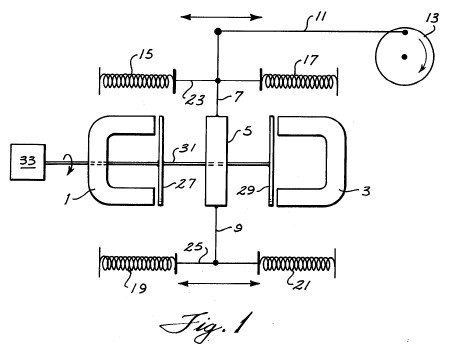
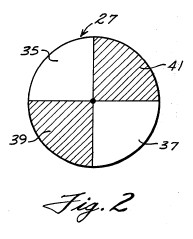
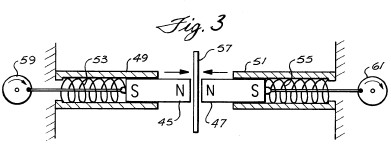
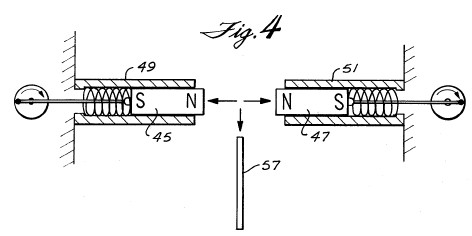
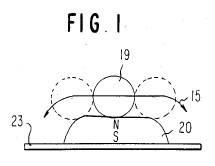
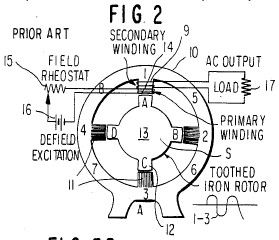
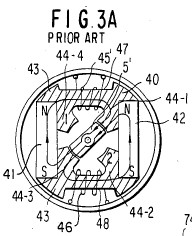
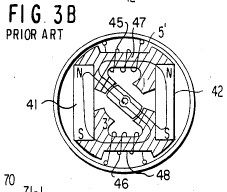
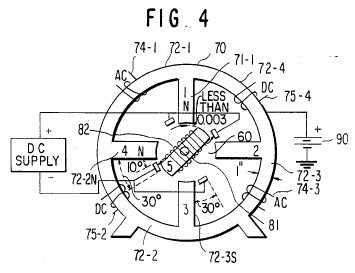
The invention uses a pair of permanent magnets and a spring-biased magnetizable (or permanent-magnet) member positioned between them. Rotatable magnetic-shield shutters alternately expose and shield the member from the magnets' fields, causing it to reciprocate. The reciprocating motion can be converted to rotary motion or, in a second embodiment, a flux-switch alternator with a stationary armature and field uses a share magnetic flux between motor and generator windings, improving efficiency.
Principles
- Magnetic attraction and repulsion
- Magnetic shielding (rotatable shutters)
- Spring biasing of movable members
- Flux-switch alternator principle
Scientific Domains
Materials
- Permanent magnets (e.g., ferrite or rare-earth)
- Soft-steel magnetic shielding material
- Steel springs
- Soft-steel rotor (high magnetic permeability)
- Laminated or powder-compacted steel for armature
Mechanisms of Action
- Alternating exposure of a magnetizable member to permanent-magnet fields
- Reciprocating motion produced by net magnetic force plus spring restoring force
- Conversion of reciprocating motion to rotary motion via linkages
- Magnetic flux sharing between motor and generator windings
Applications
- Backup power generation
- Compact motor-generator units for remote locations
- Low-loss electrical conversion in industrial settings
Claimed Performance
Device can produce useful work and convert reciprocating motion to rotary motion without additional external energy input; efficiency improvements over conventional motor-generator sets are claimed.
Limitations
- No quantitative performance data provided
- Relies on pre-magnetized permanent magnets; net energy gain not demonstrated
- Mechanical wear of rotating shutters and springs
- Scaling to high power levels may be limited by magnetic material saturation
Red Flags
- Claims of producing work without addition of external energy may imply over-unity expectations
- Lack of peer-reviewed data or independent replication