Goal
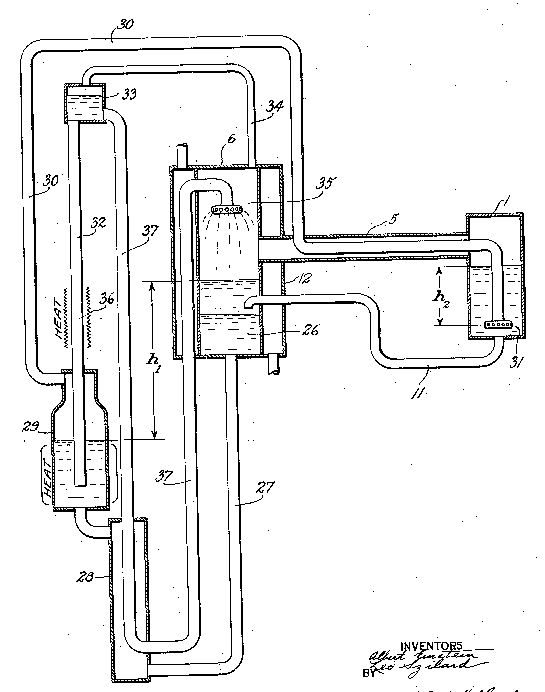
Develop an environmentally friendly refrigerator that operates without electricity and reduces greenhouse-gas emissions.
Problem
Conventional fridges use electricity and harmful freon gases, contributing to greenhouse-gas emissions and climate change.
Concept Summary
The Einstein-Szilard refrigerator uses a sealed system of pressurised gases (ammonia, butane, water) that exploits the pressure-dependent boiling point of liquids to produce cooling without moving parts. Heat (e.g., from a solar-powered pump) drives the cycle, providing refrigeration while eliminating freons.
Principles
- Pressure-temperature relationship
- Phase-change cooling
- Absorption refrigeration
Scientific Domains
Materials
- Ammonia
- Butane
- Water
Mechanisms of Action
- Evaporation of low-boiling-point butane under reduced pressure
- Heat-driven pump to recycle gases
- Condensation of ammonia in a water bath
Energy Sources
Applications
- Rural refrigeration
- Food storage in off-grid areas
- Medical supply cooling
Claimed Performance
Design tweaks could quadruple the efficiency of the original 1930 refrigerator.
Experimental Evidence
Oxford team has built a working prototype; the device is still in early stages and not commercialised.
Replication Status
Prototype completed; not yet commercialised.
Limitations
- Lower efficiency than modern compressor fridges
- Requires a reliable heat source
- Prototype stage; not yet scaled