Goal
Remove water from high-moisture soils, sludge, and clay foundations; improve drainage, soil bearing capacity, and enhance phytoremediation.
Problem
Excess water in soils, sludge, and soft clay that hinders construction, increases contaminant mobility, and reduces bearing capacity.
Concept Summary
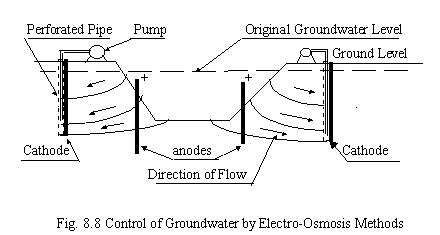
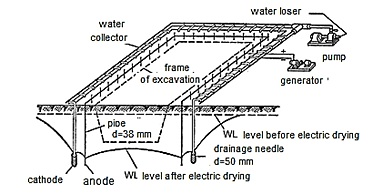
An electric field is applied across porous media (soil, sludge, clay) to induce electro-osmosis, electromigration and electrophoresis. Water is drawn toward the cathode and removed, while contaminants and particles are directed toward plant root zones or collection points. The process can be combined with geogrids, drainage pipes, and data-controlled power supplies to achieve high dewatering efficiency and soil solidification.
Detailed Description
The article lists several patents that describe devices and methods for electro-osmosis-based dewatering. Typical components include a pair of electrodes (positive and negative) placed in the ground or within a treatment cell, a power supply (220 V AC rectified to DC or a regulated DC source), water-collection bags or filter presses, data-processing units that adjust voltage based on moisture readings, and geogrids with embedded copper conductors for drainage and reinforcement. The systems can treat 80-96 % of the moisture in sludge, improve geogrid strength to 1000 kN/m, reduce harmful gas emissions, and lower treatment costs. Some embodiments also integrate phytoremediation, using plant roots to capture contaminants while the electric field directs them into the rhizosphere.
Principles
- Electro-osmosis
- Electromigration
- Electrophoresis
- Electro-kinetic transport
Scientific Domains
Materials
- Copper cores (embedded in geogrid yarns)
- Corrosion-resistant coating (e.g., polymer)
- Polyethylene water bag
- Metal electrodes (steel, copper)
- Porous filter plates
- Geogrid fibers (warp and weft yarns)
- Grouting pipe material (PVC or HDPE)
Mechanisms of Action
- Electric field induces movement of pore water toward cathode (electro-osmosis)
- Ion migration transports charged contaminants (electromigration)
- Particle movement toward electrodes (electrophoresis)
- Soil consolidation via water removal and electro-chemical reactions
Energy Sources
Applications
- Construction site soil preparation
- Sludge treatment in wastewater plants
- Soft-clay foundation stabilization
- Contaminated land remediation
- Agricultural phytoremediation
Claimed Performance
Dewatering efficiency of 80 %-96 % moisture removal from high-moisture mud; geogrid tensile strength up to 1000 kN/m; reduction of harmful gas production; cost savings in sludge treatment.
Experimental Evidence
Patents report laboratory-scale demonstrations achieving the above performance figures, but no peer-reviewed data or independent replication is provided.
Limitations
- Requires reliable electrical power
- Electrode corrosion over time
- Effectiveness limited by soil conductivity and depth
- Scale-up to large field projects not yet demonstrated