Goal
Provide silent, no-moving-parts propulsion for submarines, ships and torpedoes.
Problem
Noise from conventional screw propellers that can be detected by enemy sonar.
Concept Summary
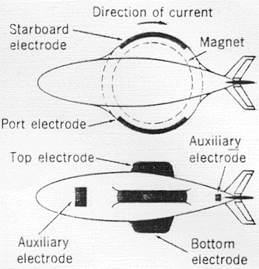
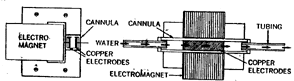
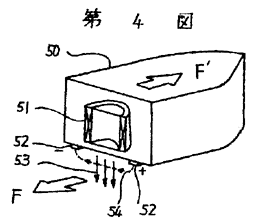
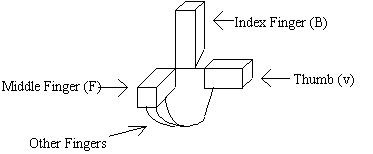
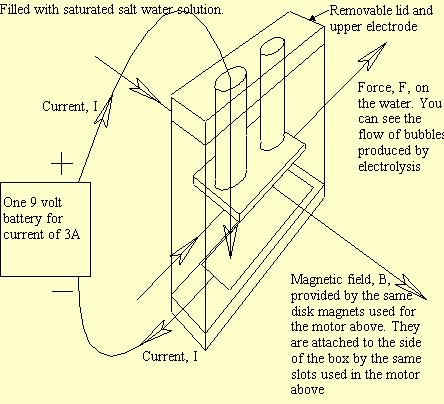
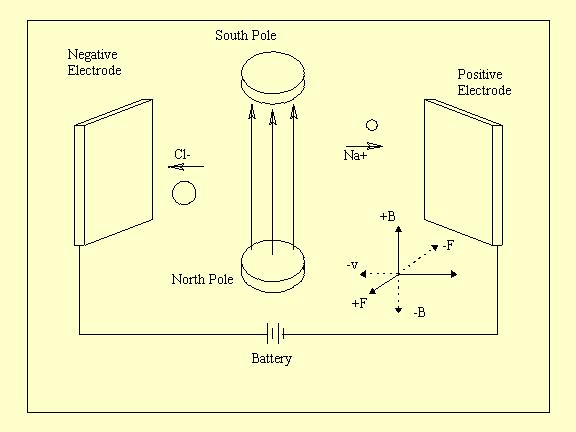
A pair of electrodes placed in a narrow chamber (cannula) are subjected to a strong magnetic field. When alternating current is applied, ions in conductive seawater are forced to move sideways by the Lorentz force, dragging water molecules with them and creating a continuous jet of water. The device has no moving mechanical parts, producing thrust silently.
Detailed Description
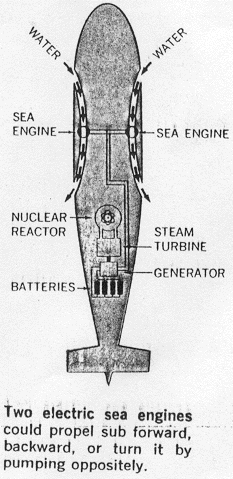
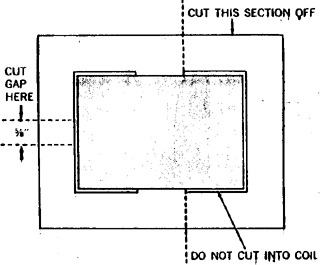
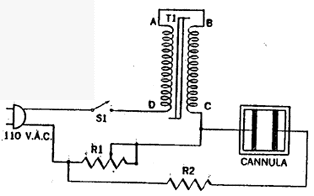
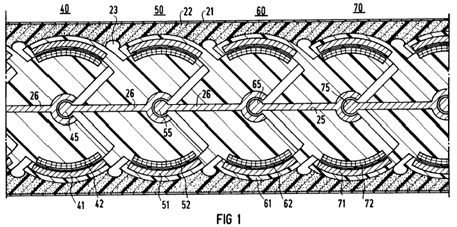
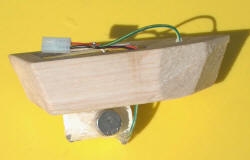
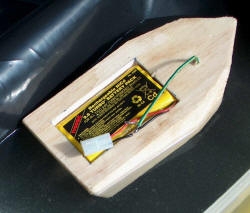
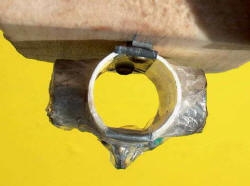
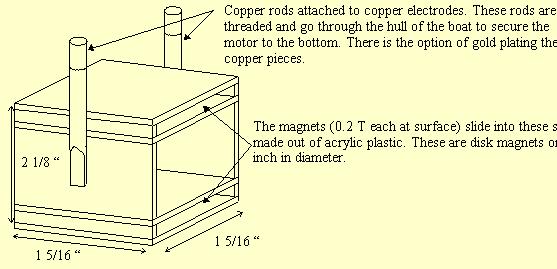
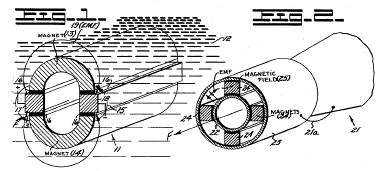
The sea engine consists of two metal plates (copper or stainless steel) mounted parallel inside a plastic tube (cannula) that sits in the gap of a powerful electromagnet. Alternating current applied to the plates ionizes the salt water (NaCl solution) between them. The external magnetic field repels the magnetic fields of the moving ions, causing them to move laterally and drag water out of the cannula, producing a thrust jet. The direction of thrust can be reversed by switching the polarity of the current. Prototypes have been built using a 100-W isolation transformer, resistors, and simple plastic/glass tubing, and larger designs have been proposed using superconducting magnets and high-capacity batteries or nuclear power for larger submarines.
Principles
- Lorentz force
- Magnetohydrodynamics (MHD)
- Electromagnetic induction
Scientific Domains
Materials
- Copper
- Stainless steel
- Sodium chloride (salt)
- Water
Mechanisms of Action
- Ion motion in a magnetic field drags water molecules
- Alternating current creates oscillating ion flow
- Magnetic field forces ions sideways, producing net water flow
Energy Sources
Applications
- Silent propulsion for submarines
- Torpedo propulsion
- Quiet surface ship maneuvering
- Medical blood-pump devices
Claimed Performance
Prototype 10-ft model (~=900 lb) achieved ~0.5 knot speed with a 15-minute run; a 15-ton design with superconducting magnets projected ~6 knots for 9 hours using ~2 tons of batteries; larger concepts claim up to 25 knots for 100 000-ton cargo subs.
Experimental Evidence
Popular Science (1966) describes a working DIY sea engine that moves salt water; Product Engineering (1969) reports a 10-ft prototype that ran for 15 minutes at 0.5 knot; a 15-ton design study estimates performance based on battery mass and superconducting magnet efficiency.
Replication Status
Prototype built and demonstrated by hobbyists and by researchers; no commercial scale deployment reported.
Limitations
- Requires high electrical power or large batteries
- Electrode corrosion in salt water
- Low thrust-to-size ratio compared with propellers
- Need for strong magnetic fields (large or superconducting magnets)
Red Flags
- Performance claims based on limited prototype data
- Lack of peer-reviewed experimental results