Goal
Extract thermal energy from coal without conventional combustion while capturing virtually all CO_2 emissions.
Problem
High CO_2 emissions and other pollutants from traditional coal-fired power plants.
Concept Summary
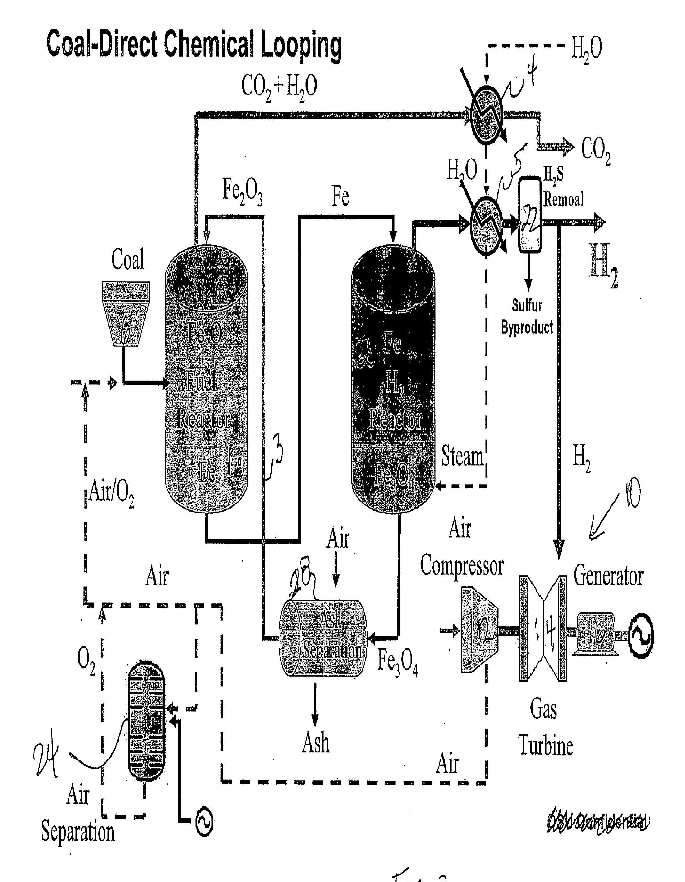
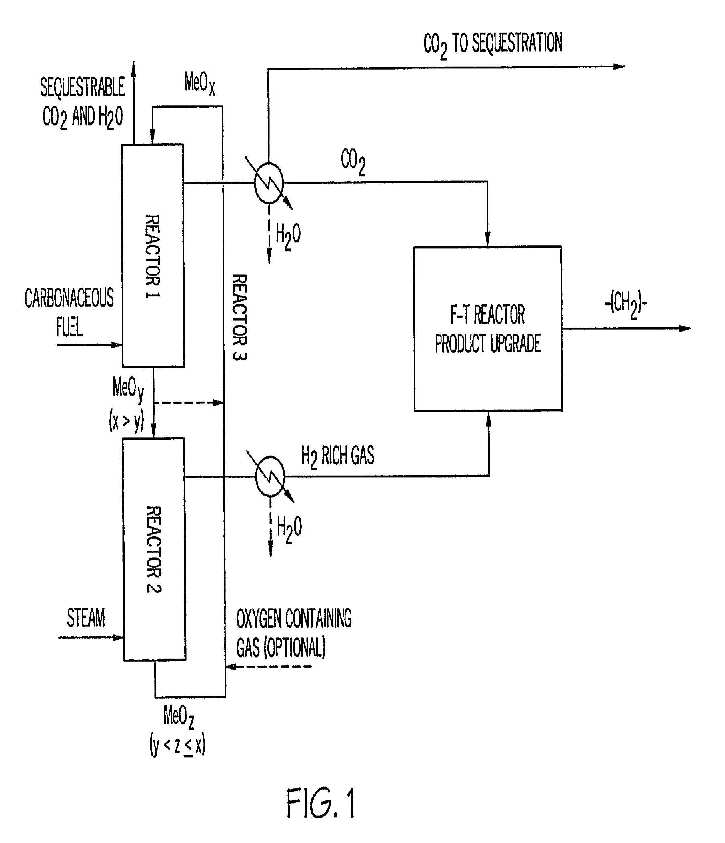
CDCL uses iron-oxide-based oxygen-carrier beads that chemically oxidize powdered coal in a sealed reactor. The redox reaction releases heat, produces CO_2 that is captured inside the reactor, and leaves behind ash. The reduced iron oxide is re-oxidized with air for reuse, enabling continuous operation with near-complete carbon capture.
Detailed Description
In the Ohio State research-scale unit, coal is ground to ~100 um particles and mixed with 1.5-2 mm iron-oxide composite beads inside an insulated metal cylinder. At high temperature the coal carbon reduces the iron oxide, forming CO_2 (captured in a separate chamber) and leaving hot ash and reduced iron. The reduced iron is regenerated by exposure to air, completing the loop. Each unit delivers ~25 kW thermal power; a larger pilot plant under construction will produce 250 kW. The system has operated continuously for 203 h in a single run and 830 h total across multiple sub-pilot runs, achieving 99 % CO_2 capture.
Principles
- Chemical looping
- Redox (oxidation-reduction) reactions
- Oxygen-carrier mediated combustion
- Carbon capture
Scientific Domains
Materials
- Iron oxide (Fe_2O_3/Fe_3O_4) composite beads
- Coal powder
- Ceramic support material (e.g., alumina)
- Ash (by-product)
Mechanisms of Action
- Coal carbon reduces iron-oxide oxygen carrier
- Heat released from exothermic redox reaction
- CO_2 generated and retained in reactor for capture
- Regeneration of iron oxide by oxidation with air
Energy Sources
Applications
- Power generation with near-zero CO_2 emissions
- Industrial heat production
- Carbon-capture-enabled coal utilization
Claimed Performance
99 % CO_2 capture; 25 kW thermal output per research unit; 250 kW planned pilot; 830 h combined operating time with continuous runs of 203 h.
Experimental Evidence
Research-scale unit operated continuously for 203 h, delivering heat and capturing 99 % of CO_2; total of 830 h of operation across multiple runs; larger 250 kW pilot under construction at the U.S. DOE National Carbon Capture Center.
Replication Status
Research-scale units successfully demonstrated at Ohio State; larger pilot plant under construction (no commercial deployment yet).
Limitations
- Scale-up to utility-size plants requires large reactors and robust oxygen-carrier handling
- High-temperature material durability
- Economic competitiveness with renewable energy sources