Goal
Produce usable energy, generate motive force without reactive mass flow, and provide protection from nuclear radiation.
Problem
Need for clean, low-radiation energy sources and propulsion methods that avoid nuclear waste and hazardous radiation.
Concept Summary
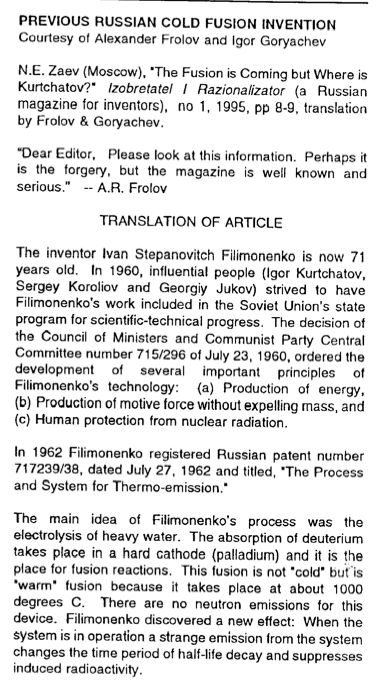
Filimonenko's concept uses electrolysis of heavy water (deuterium-enriched water) in a palladium cathode. Deuterium is absorbed into the palladium lattice and undergoes a low-temperature (~=1000 deg C) fusion-like reaction that supposedly yields large thermal power with no neutron emission. The system is claimed to concentrate energy (syntropy), suppress induced radioactivity, and generate antigravity thrust by altering space-time curvature.
Detailed Description
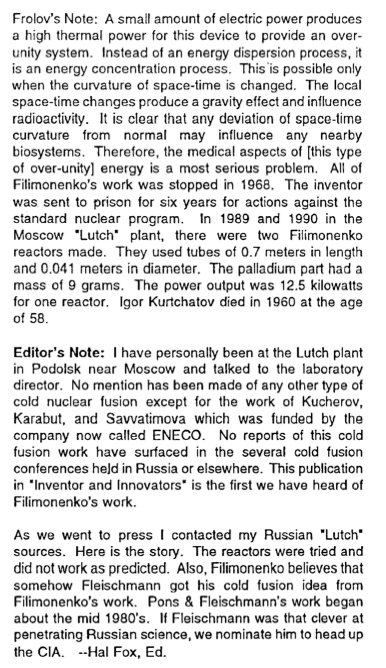
The patented "Process and System for Thermo-emission" (US 717239/38, 1962) describes a reactor where heavy water is electrolyzed; deuterium ions migrate into a hard palladium cathode where they fuse at ~1000 deg C. The reaction allegedly produces high thermal output (e.g., 12.5 kW per 0.7 m tube with a 9 g palladium cathode) while consuming only a small electric input, thus achieving over-unity. The inventor further claimed that the operating system emits a "strange emission" that lengthens half-life periods of radioactive isotopes, providing radiation shielding, and that the curvature of space-time is altered, yielding a syntropic (energy-concentrating) process and antigravity effects useful for propulsion.
Principles
- Electrolysis of heavy water
- Deuterium absorption in palladium lattice
- Low-temperature (~=1000 deg C) fusion-like reaction
- Energy concentration (syntropy) versus entropy
- Space-time curvature alteration (TRC theory)
- Anti-gravity thrust generation
Scientific Domains
Materials
- Heavy water (deuterium oxide)
- Palladium (cathode)
- Stainless steel tube (reactor body)
Mechanisms of Action
- Deuterium-palladium fusion
- Thermal power generation from exothermic reaction
- Radiation suppression via emitted fields
- Momentum thrust from interaction with Earth's magnetic field
Energy Sources
Applications
- Clean energy generation
- Propulsion without propellant
- Radiation shielding for spacecraft
Claimed Performance
Each 0.7 m reactor (0.041 m diameter, 9 g Pd) produced 12.5 kW of thermal power; a separate claim of a 5-metric-ton lift capability for a flying-saucer-type craft.
Experimental Evidence
In 1989-1990 a Moscow plant "Lutch" built two Filimonenko reactors (0.7 m tubes, 0.041 m diameter, 9 g Pd) that reportedly delivered 12.5 kW each. No independent measurements or peer-reviewed data are provided.
Replication Status
No independent replication reported; development halted in 1968 and later prototypes were not publicly verified.
Limitations
- No peer-reviewed or independently verified data
- Claims of over-unity and antigravity lack physical explanation
- Scalability and material durability not demonstrated
- Potential safety concerns from unverified radiation suppression
Red Flags
- Over-unity claim without quantitative validation
- Anti-gravity and space-time curvature assertions outside mainstream physics
- Narrative of conspiratorial suppression and martyrdom
- Absence of peer-reviewed publications or independent replication