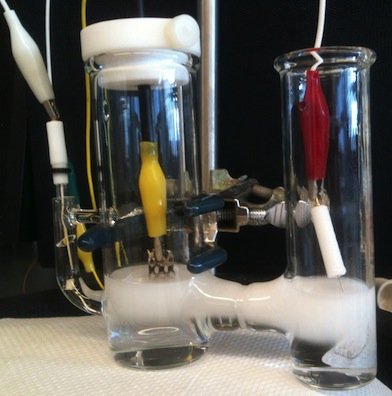
Goal
Produce hydrogen fuel from water with low energy input by using cheap, high-performance electrocatalysts.
Problem
High overpotentials and expensive rare-metal catalysts limit large-scale water electrolysis for hydrogen production.
Concept Summary
The invention uses a low-temperature photochemical or near-infrared driven decomposition of inexpensive metal salts to form amorphous mixed-metal oxide films (e.g., a-Fe100-y-CoyNizOx). These films act as highly active oxygen-evolution catalysts, reducing the electrical energy required for water splitting and enabling scalable, low-cost hydrogen generation.
Detailed Description
A scalable preparative method deposits metal-salt precursors onto a substrate (glass, plastic, FTO, etc.) and exposes them to either UV-photochemical decomposition or near-infrared (NIR) radiation. The localized heating liberates ligands, forming amorphous metal oxide (a-MOx) or reduced metal (a-M) films without reaching temperatures that would produce crystalline phases. The resulting amorphous catalysts exhibit homogeneous metal distribution and superior OER activity comparable to noble-metal oxides. The technology is being pursued by FireWater Fuel Corp. for electrolyzer prototypes aimed at renewable-energy storage and consumer-grade hydrogen production.
Principles
- Electrochemical catalysis
- Photochemical metal-organic deposition
- Near-infrared driven decomposition
- Amorphous metal oxide formation
Scientific Domains
Materials
- Iron salts (FeCl_3, Fe(NO_3)_3)
- Nickel salts (NiCl_2, Ni(NO_3)_2)
- Cobalt salts (CoCl_2, Co(NO_3)_2)
- Iridium salts
- Manganese salts
- Copper salts
- Amorphous mixed-metal oxides (a-Fe100-y-CoyNizOx)
- Fluorine-doped tin oxide (FTO) coated glass
- Plastic substrates
- Glass substrates
Mechanisms of Action
- Oxygen evolution reaction (OER) catalysis
- Water splitting
- Photochemical decomposition of metal precursors
- NIR-induced localized heating
Energy Sources
Applications
- Hydrogen fuel generation
- Renewable energy storage
- Smart textiles
- Electrochromic windows
- Industrial electrolyzers
Claimed Performance
Second-generation catalyst outperforms current state-of-the-art OER catalysts, delivering high anodic efficiencies and requiring less electricity than uncatalyzed water splitting; laboratory demonstrations show comparable activity to noble-metal oxides.
Experimental Evidence
Laboratory tests with Fe_4_0Ni_6_0O films and a-Fe100-y-CoyNizOx films show high OER activity; peer-reviewed publications in Science (2013) and Science Advances (2015) provide quantitative performance data; video presentations demonstrate prototype operation.
Replication Status
Published in peer-reviewed journals and patented; company plans commercial prototype; no independent third-party replication reported.
Limitations
- Scalability of the low-temperature deposition process not yet demonstrated at commercial scale
- Optimal temperature and lamp intensity parameters still under investigation
- Long-term durability of amorphous catalysts in real-world electrolyzers