Goal
Generate thermonuclear energy (heat) via acoustic cavitation of liquid metal.
Problem
Provide a method to produce net energy gain using fusion reactions without conventional high-temperature plasma confinement.
Concept Summary
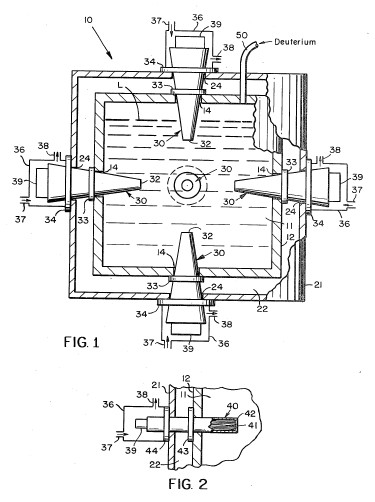
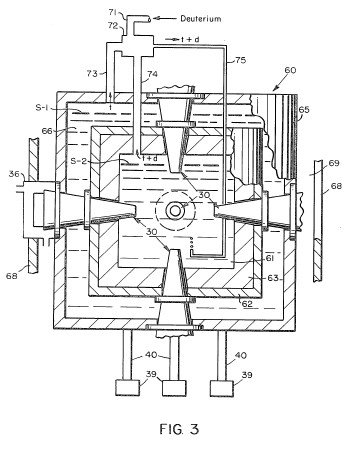
Acoustic horns induce pressure waves in a sealed chamber containing a liquid metal (e.g., lithium, beryllium). The pressure variations create cavitation bubbles that grow and collapse violently, causing adiabatic compression that raises temperatures and pressures enough for hydrogen isotopes (deuterium, tritium) to undergo fusion. The resulting heat is extracted through the acoustic horns to an external heat exchanger.
Principles
- Acoustic cavitation
- Adiabatic compression
- Thermonuclear fusion of hydrogen isotopes
- Magnetic pulse gravity cancellation
Scientific Domains
Materials
- Lithium
- Lithium alloy
- Beryllium
- Aluminum
- Tin
- Indium
- Thallium
- Deuterium
- Tritium
Mechanisms of Action
- Acoustic pressure waves generate cavitation bubbles in liquid metal
- Bubble collapse produces extreme temperature and pressure
- Hydrogen isotopes in the bubble and host liquid undergo fusion
- Heat is transferred to the liquid metal and removed via acoustic horns
Energy Sources
Applications
- Heat generation
- Power generation
- Isotope production (helium-4, tritium)
Claimed Performance
Device of ~20 g produced ~100 W of heat from 50 W of acoustic input (~=2x net gain).
Experimental Evidence
In a tiny device of 20 g he produces piezoelectrically in heavy water bursting bubbles that generate about 100 watts of energy with an input of 50 watts.
Limitations
- No independent peer-reviewed verification
- Scalability of liquid-metal handling
- Potential low overall efficiency
Red Flags
- Claims of overunity without rigorous experimental data
- Historical controversy surrounding cold-fusion research