Goal
Generate ultra-short, high-power microwave electromagnetic pulse (EMP) bursts for testing radiolocators, simulating nuclear or lightning EMPs, and for functional destruction of semiconductor radio-electronic equipment.
Problem
Need for high-power, short-duration EMP sources to improve radiolocator range/resolution, test durability of energy-system electronics, and develop electromagnetic weapon capabilities.
Concept Summary
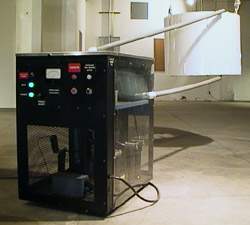
Russian scientists created a relativistic microwave generator capable of emitting extremely short, high-power microwave pulses (peak power in the gigawatt range). The system uses a resonant pulse compressor and tunable antenna to focus microwave energy onto a target, allowing detection of harmonic responses and functional destruction of semiconductor electronics.
Principles
- Relativistic microwave generation
- Pulse compression
- Resonant frequency tuning
- Harmonic signal detection
Scientific Domains
Mechanisms of Action
- Heavy microwave flux irradiation
- Detection of even-harmonic reflected signals
- Amplitude-frequency response analysis
- Incremental increase of microwave density at resonant frequency
Energy Sources
Applications
- Testing durability of energy-system electronics
- Simulating nuclear or lightning EMP effects
- Electromagnetic weapon development
Claimed Performance
Peak capacity reaches billions of watts, comparable to a nuclear power plant.
Limitations
- Requires extremely high-power electrical supply
- Complex resonant pulse-compression hardware
- Limited publicly verified experimental data
Red Flags
- Potential use in weaponization
- Lack of independent peer-reviewed validation