Goal
Enable cultivation of terrestrial plants underwater to provide a stable, pest-free environment and expand agricultural production in arid coastal regions.
Problem
Limited arable land and water scarcity on land, temperature fluctuations, and pest/parasite damage to crops.
Concept Summary
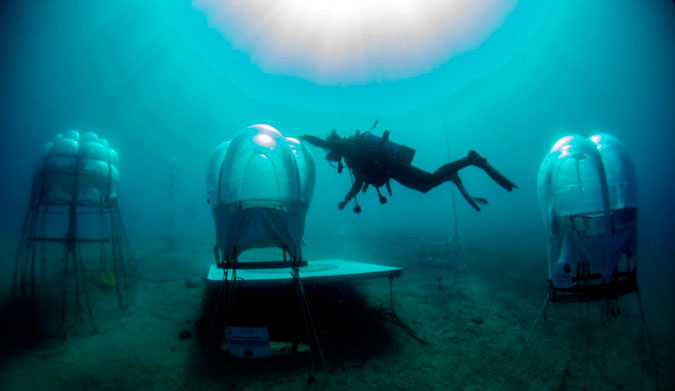
A flexible, air-filled balloon made of water-impermeable but light-permeable material is anchored to the seabed. Inside, shelves hold seedbeds while vent valves control the air-water interface. Water-tight transport containers allow seedbeds to be moved without water contact. The system relies on natural sunlight, stable sea temperature, and humidity generated by evaporation/condensation.
Detailed Description
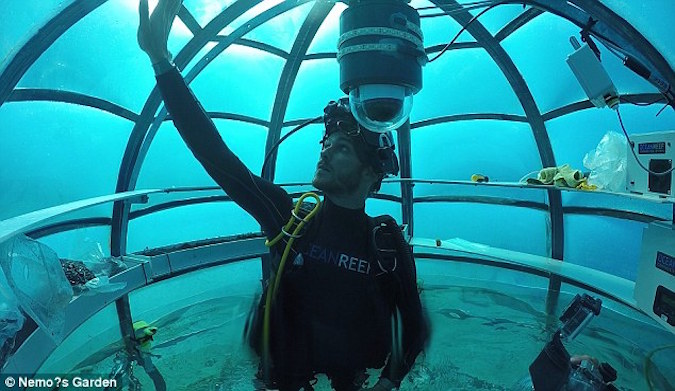
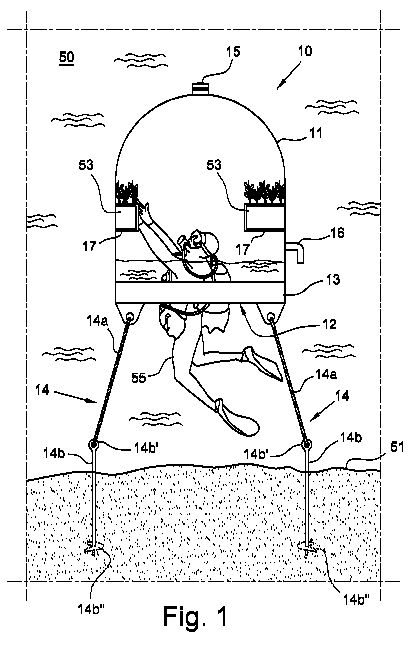
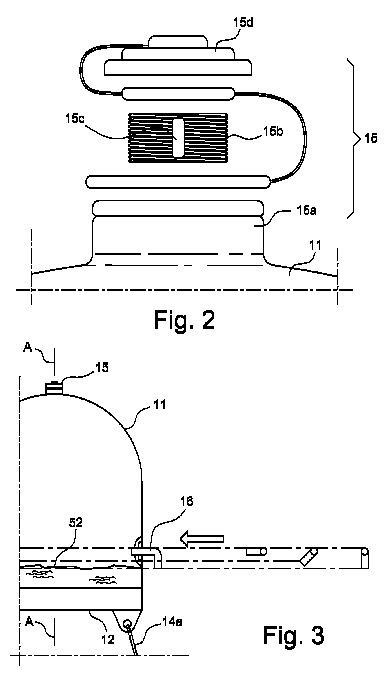
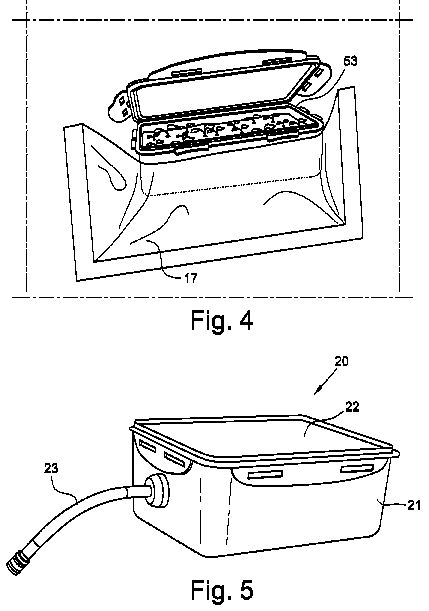
The invention comprises a balloon (11) that is filled with air and anchored to the seabed by cables (14) and ballast anchors (14b). The balloon material is impermeable to water yet permeable to light, allowing solar radiation to reach the plants. A rigid ring (13) reinforces the lower access aperture. Two vent valves (15, 16) regulate internal air pressure and the water-air interface. Inside, support shelves (17) hold seedbeds (53) and runoff drains. Seedbeds are transferred in special water-tight containers (20) that can be positively buoyant for easy retrieval. The system can be entered by a diver for maintenance, and an underwater communication pocket may be added. The design maintains a stable temperature (~=25-29 deg C) and high humidity (80-90 %).
Principles
- Light permeability
- Buoyancy and pressure control
- Thermal stability of seawater
- Sealed air-filled environment
- Evaporation-condensation humidity regulation
Scientific Domains
Materials
- Flexible waterproof polymer (e.g., PVC, polyethylene)
- Rigid ring element (metal or reinforced plastic)
- Cables (nylon or steel)
- Anchors with rotary auger (metal)
- Water-tight container body (plastic)
- Vent valve components (metal/plastic)
- Support shelves (flexible polymer pockets)
Mechanisms of Action
- Provides stable temperature via seawater thermal inertia
- Maintains high humidity through evaporation and condensation
- Protects plants from insects and parasites by isolating them from surrounding water
- Delivers sunlight through transparent balloon material
- Controls internal air volume to prevent balloon lift
Energy Sources
Applications
- Food production in arid coastal regions
- Supplemental crop production for islands
- Tourist attractions (underwater farms)
- Research on marine-based agriculture
Claimed Performance
Plants grown underwater showed denser foliage than typical surface growth; internal temperature reached 29 deg C while ambient water was 25 deg C; humidity remained 80-90 %; successful cultivation of basil and ongoing experiments with lettuce, mushrooms, tomatoes, and green beans.
Experimental Evidence
The inventor reports four seasons of production with three biospheres, yielding more densely-leafed basil and successful harvests; a lettuce trial is underway; the system has been selected as one of 20 Italian food-related innovations for the World Expo in Milan.
Limitations
- High initial deployment cost
- Dependence on sufficient sunlight
- Anchoring and durability in strong currents
- Limited scalability without extensive infrastructure