Goal
Provide electricity-free cooling for buildings and low-cost solar-driven water desalination.
Problem
Need for passive cooling in dense urban environments and affordable, electricity-free solar desalination.
Concept Summary
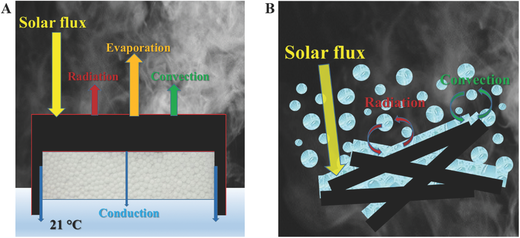
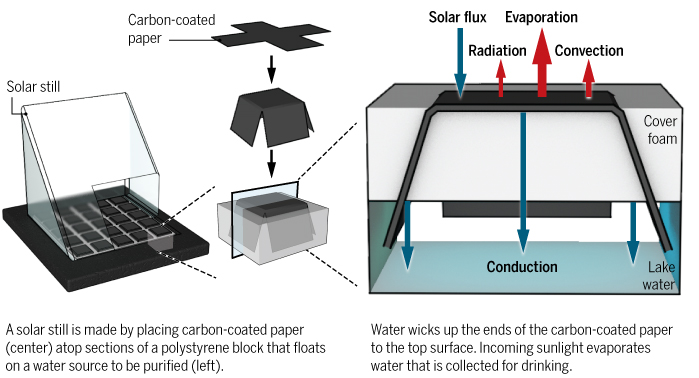
A low-cost system combines a polymer/aluminum radiative-cooling film with a carbon-black-dyed cellulose-polyester blend on expanded polystyrene foam. The film reflects sunlight and radiates heat to the sky, while the black substrate absorbs solar energy and evaporates water, producing distilled water and cooling the surrounding air.
Detailed Description
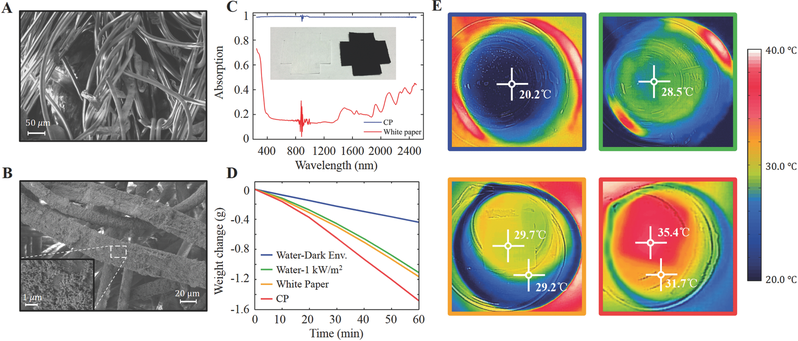
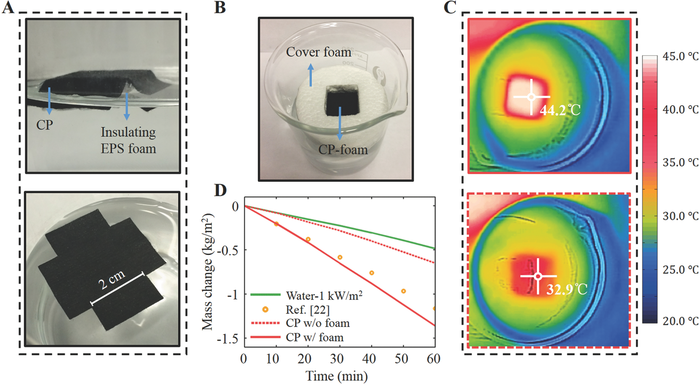
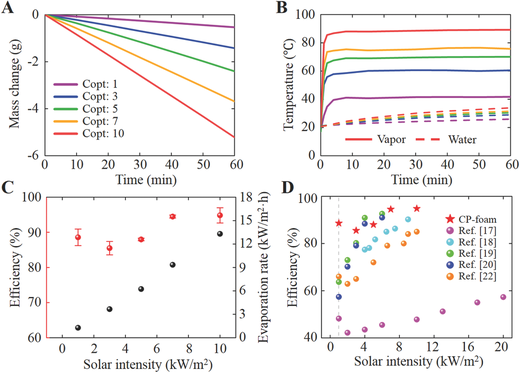
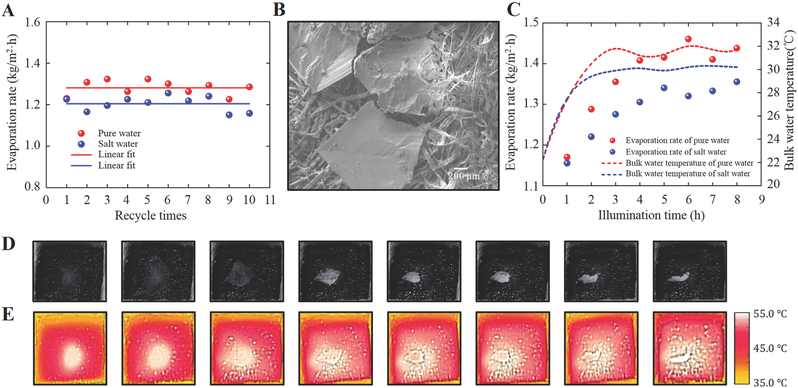
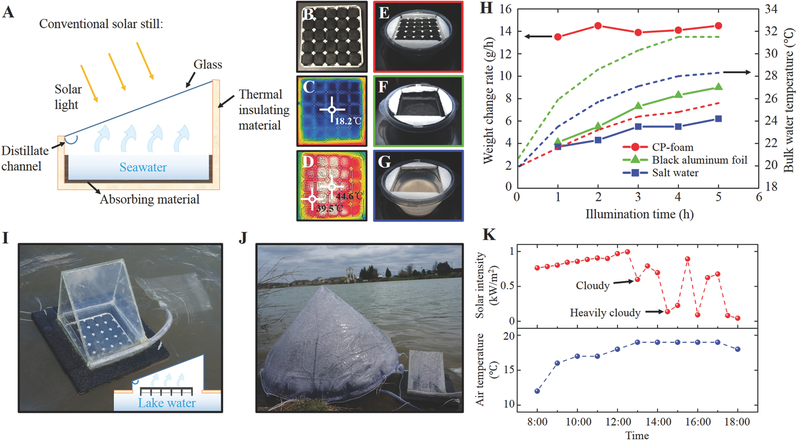
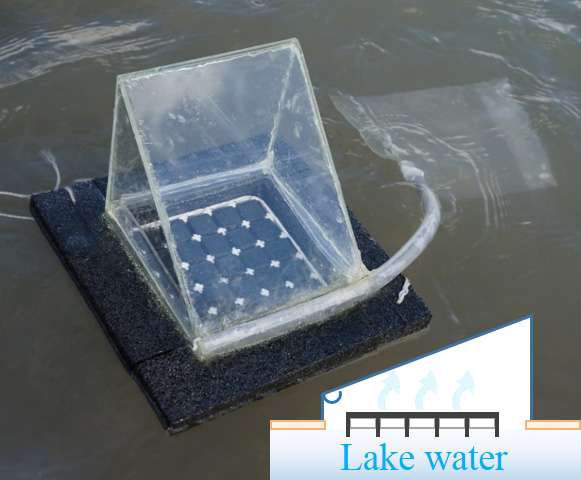
The core of the system is a sheet of aluminum coated with polydimethylsiloxane (PDMS) that reflects solar radiation and radiates thermal infrared to space. This film is placed at the bottom of a foam box beneath a solar "shelter" that blocks direct sunlight and shapes the thermal emission toward the sky. In the desalination variant, a carbon-black-dyed cellulose-polyester (CCP) blend is laid on expanded polystyrene (EPS) foam. The black substrate absorbs solar energy, heats up, and drives evaporation of water below it; the foam provides insulation and reduces heat loss to the environment. The design achieves a measured temperature drop of ~6 deg C (day) to ~11 deg C (night) for the cooling version and a thermal conversion efficiency of ~88 % for the vapor-generation version, delivering water-generation rates up to 2.4x those of commercial solar stills and vapor production up to 3x natural evaporation. Laboratory and outdoor experiments demonstrated stable performance over multiple hours, with salt accumulation on the carbon substrate causing only modest performance loss.
Principles
- Radiative cooling
- Solar absorption
- Evaporative cooling
- Beam-shaping of thermal emission
- Passive heat transfer
Scientific Domains
Materials
- Aluminum
- Polydimethylsiloxane (PDMS)
- Carbon black
- Cellulose
- Polyester
- Expanded polystyrene (EPS) foam
Mechanisms of Action
- Reflection of solar radiation by aluminum
- Infrared emission to sky via PDMS coating
- Solar-driven heating of black substrate
- Phase-change evaporation of water
- Condensation of vapor into distilled water
Energy Sources
Applications
- Building cooling in urban environments
- Low-cost solar desalination
- Fresh-water generation in resource-limited areas
- Solar-driven salt harvesting
Claimed Performance
Temperature reduction up to 6 deg C (day) and 11 deg C (night); thermal conversion efficiency ~= 88 %; water-generation rate 2.4x commercial solar stills; vapor generation ~= 3x natural evaporation.
Experimental Evidence
Laboratory measurements showed a 6 deg C cooling effect during daytime and 11 deg C at night. Outdoor tests recorded water-weight loss indicating vapor generation rates 2.4x higher than a commercial product and 3x higher than natural evaporation. Thermal images confirmed surface temperatures below ambient under low-light conditions. Salt accumulation experiments demonstrated only slight performance degradation.
Replication Status
Only the authors' own laboratory and outdoor tests are reported; no independent replication is mentioned.
Limitations
- Performance depends on solar irradiance; reduced output on cloudy days
- Salt buildup on black substrate can slightly lower efficiency
- Multiple units required to achieve meaningful building-scale cooling
- No demonstrated large-scale commercial deployment
Red Flags
- Claim of > 100 % energy conversion (vapor generation exceeding solar input) relies on ambient heat contribution and may be misinterpreted as over-unity
- No independent third-party validation of the reported 88 % efficiency