Goal
To determine whether elemental transmutations occurring in biological entities can serve as a new source of energy.
Problem
The lack of a known mechanism for harnessing energy from reported biological transmutations and the need to assess their energetic viability.
Concept Summary
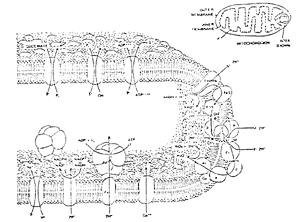
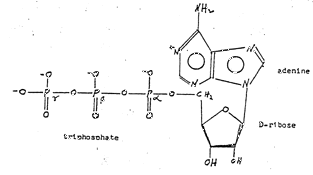
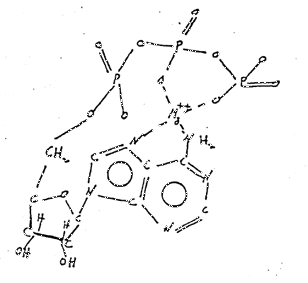
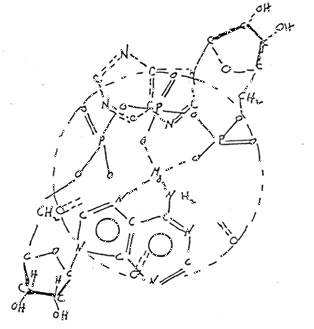
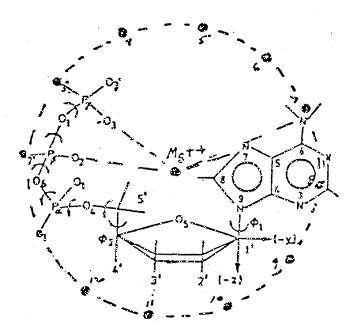
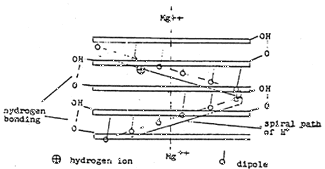
The report surveys literature on biological elemental transmutations (Na->Mg, K->Ca, Mn->Fe) and proposes that Mg-Adenosine Triphosphate (MgATP) in mitochondria can act as a molecular-scale cyclotron, facilitating nuclear reactions that yield a net energy surplus. The mechanism involves oscillatory magnetic fields, hydrogen ion ring currents, and dipole interactions within layered MgATP structures.
Principles
- Nuclear transmutation
- Molecular cyclotron behavior of MgATP
- Oscillatory magnetic fields
- Hydrogen ion ring current induction
- Dipole interactions in layered MgATP
Scientific Domains
Materials
- MgATP
- Magnesium ion
- ATP
- Hydrogen ion (H+)
- Sodium
- Potassium
- Manganese
- Calcium
- Iron
- Lithium
Mechanisms of Action
- MgATP acts as a cyclotron, accelerating H+ ions
- Induced magnetic fields cause hydrogen ions to follow circular helical paths
- Proposed fusion/fission reactions (Na+H -> Mg, K+H -> Ca, Mn+H -> Fe) produce MeV-scale energy
Energy Sources
Applications
- Energy generation for military or civilian use
- Propulsion systems
- Power supply for remote devices
Claimed Performance
Theoretical net energy gain of ~7.3 MeV per Na->Mg, ~8.4 MeV per K->Ca, and ~10.2 MeV per Mn->Fe transmutation, suggesting a surplus energy source if reactions occur biologically.
Experimental Evidence
The article provides calculations and literature references but does not present original experimental data demonstrating the transmutations or energy production.
Limitations
- No direct experimental validation of claimed transmutations
- Mechanism relies on unverified nuclear processes in biology
- Potential safety concerns of uncontrolled nuclear reactions
Red Flags
- Claims of nuclear transmutation in living organisms without peer-reviewed evidence
- Reliance on speculative mechanisms and calculations
- Absence of independent replication or experimental demonstration