Goal
Create a homogeneous object that automatically returns to an upright position after being tipped, without any internal counterweights or external actuation.
Problem
Need for a passive self-righting mechanism that relies solely on geometry rather than added mass or active control.
Concept Summary
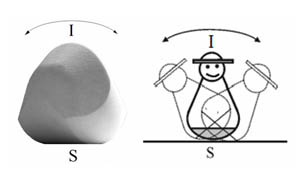
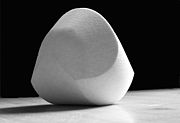
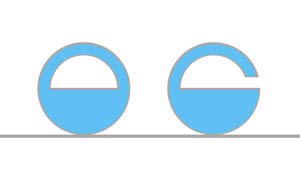
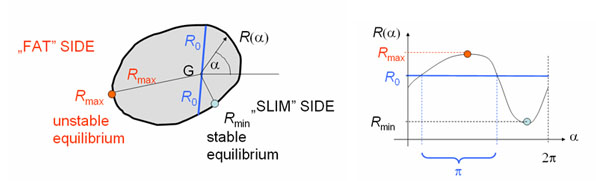
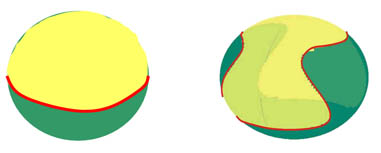
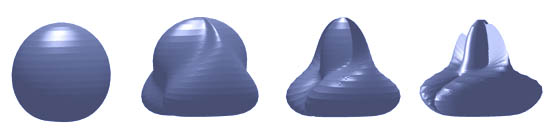
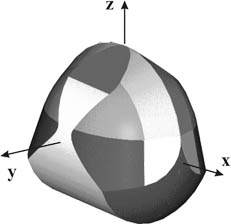
The Gomboc is a convex, homogeneous three-dimensional shape that possesses exactly one stable and one unstable equilibrium point. Its geometry causes the center of gravity to lie slightly below the geometric center, so when placed on a flat surface it naturally rolls toward the stable equilibrium, righting itself from any orientation.
Detailed Description
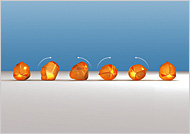
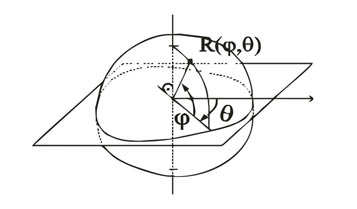
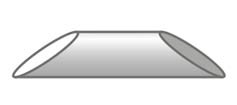
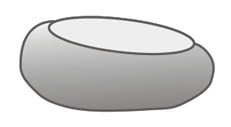
The shape is manufactured from a clear synthetic homogeneous material (e.g., plastic). It is constructed from segments of simple surfaces such as cylinders, ellipsoids, cones, and planes, forming a convex body resembling a tennis-ball-shaped object. Numerical analysis shows the center of gravity is positioned to ensure a single stable equilibrium. When the object is tipped, gravity creates a torque that drives it to roll downhill on its surface until it reaches the unique stable point, after which it remains upright. No hidden weights or moving parts are required; the self-righting behavior is entirely a result of the object's geometry and mass distribution.
Principles
- Convex geometry
- Homogeneous mass distribution
- Static equilibrium analysis
- Center-of-gravity offset
- Rolling dynamics under gravity
Scientific Domains
Materials
- Clear synthetic polymer (homogeneous material)
Mechanisms of Action
- Shape-induced torque drives the object toward the stable equilibrium
- Single stable equilibrium ensures deterministic righting
- Absence of counterweight - geometry alone provides restoring moment
Applications
- Passive self-righting devices for toys
- Stabilization components for small robots or drones
- Educational demonstrations of geometry and physics
Claimed Performance
The Gomboc always rights itself regardless of the initial orientation on a flat surface.
Experimental Evidence
A prototype was manufactured and manually tipped over; it consistently returned to the upright position. The authors also tested 2,000 natural pebbles and found none exhibited the same mono-monostatic behavior.
Replication Status
Prototype demonstrated; no large-scale production or commercial deployment reported.
Limitations
- Requires precise manufacturing tolerances to maintain mono-monostatic behavior
- Only works on flat, horizontal surfaces
- Limited to static gravity-driven environments