Goal
Provide a fast-charging, non-combustible, high-energy-density rechargeable battery.
Problem
Safety hazards (flammable liquid electrolytes), low energy density, slow charge rates, dendrite formation limiting cycle life in conventional lithium-ion batteries.
Concept Summary
The invention replaces liquid electrolytes with a glass-based solid electrolyte that conducts alkali-metal ions (Li^+, Na^+, K^+) while being an electronic insulator. The glass electrolyte enables dendrite-free plating/stripping of alkali-metal anodes, high dielectric constant for enhanced charge storage, and operation over a wide temperature range, resulting in a safer, faster-charging battery with higher volumetric energy density.
Detailed Description
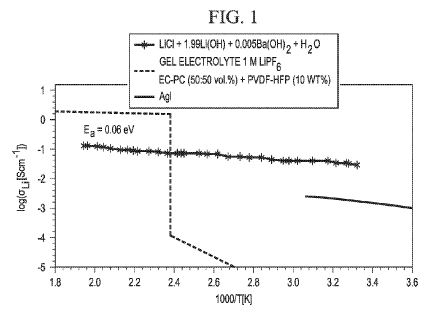
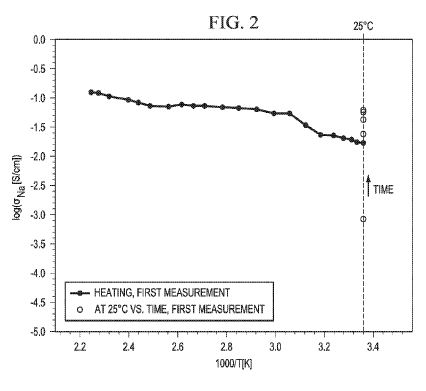
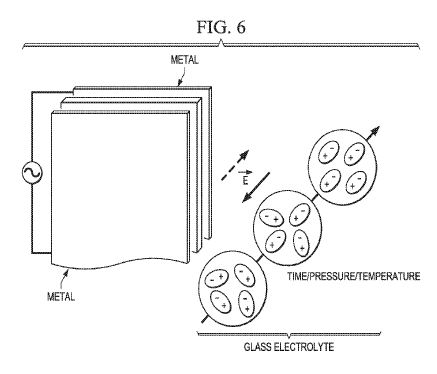
Goodenough and colleagues developed a dried, water-solvated glass/amorphous solid electrolyte that conducts Li^+ or Na^+ with ionic conductivity >10^-^2 S cm^-^1 at 25 deg C and a large dielectric constant. The electrolyte is wet by metallic alkali-metal anodes, allowing plating and stripping without dendrite formation. Battery cells built with this glass electrolyte demonstrated >1 200 charge-discharge cycles, three-fold higher energy density than commercial Li-ion cells, and reliable operation from -20 deg C to 60 deg C. The material can be processed as a paste, dry-pressed into thin films, and used as both electrolyte and separator in rechargeable batteries, fuel cells, electrolyzers, and electric-double-layer capacitors.
Principles
- Solid-state ion conduction
- High dielectric constant for electric-double-layer capacitance
- Alkali-metal plating/stripping without dendrites
- Temperature-stable ionic conductivity
Scientific Domains
Materials
- Lithium-glass electrolyte (Li-glass)
- Sodium-glass electrolyte (Na-glass)
- Water-solvated glass/amorphous solid
- BaKPO_4 (proton conductor)
- Precursors: LiOH, LiCl, NaCl, Ba(OH)_2, Sr(OH)_2, BaO, SrO, CaO, MgO, Al_2O_3, B_2O_3, SiO_2
Mechanisms of Action
- Ion transport through glass electrolyte
- Metal plating/stripping at electrodes
- Suppression of dendrite growth via electronic insulation
- Enhanced capacitance via large dielectric constant
Energy Sources
Applications
- Electric vehicles
- Portable electronics
- Stationary energy storage
Claimed Performance
>=3x energy density of current Li-ion batteries; >1 200 charge-discharge cycles; fast charge in minutes; operation from -20 deg C to 60 deg C; high volumetric energy density.
Experimental Evidence
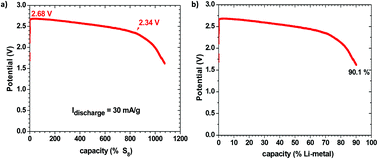
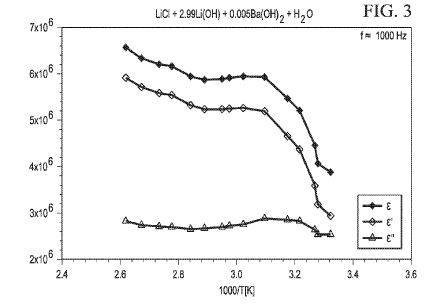
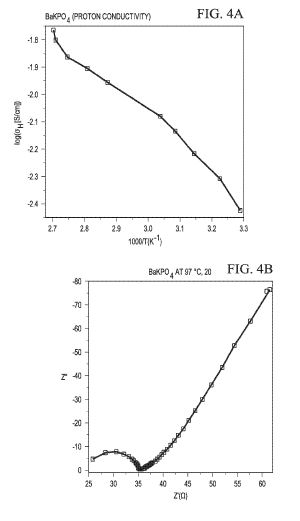
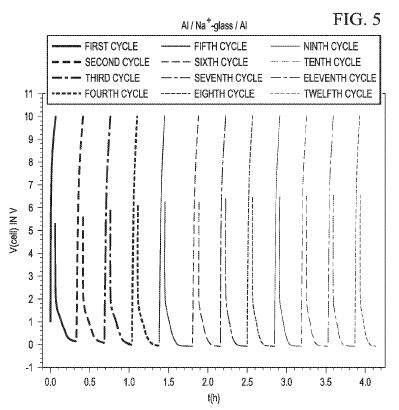
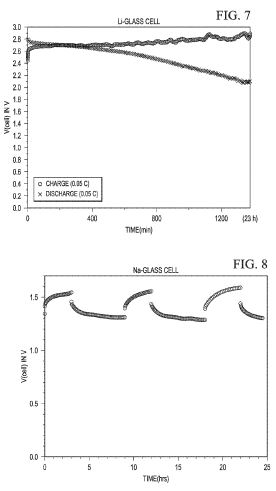
Lab tests showed ionic conductivity >10^-^2 S cm^-^1, >1 200 cycles with low resistance, and energy density three times that of commercial Li-ion cells. Figures in the patent demonstrate Arrhenius plots, dielectric constant measurements, and charge-discharge curves for Li-glass and Na-glass cells.
Replication Status
Demonstrated in laboratory prototypes; no commercial scale-up reported.
Limitations
- Scalable manufacturing of glass electrolyte
- Long-term stability beyond 1 200 cycles
- Cost of precursor materials and drying process
- Integration with existing cathode technologies