Goal
Increase the perceptive ability of the unaided eye by projecting a controllable spot of light into the line of vision of the other eye, allowing observation of dark scenes without a flashlight.
Problem
Difficulty seeing in darkness or low-light conditions without external illumination.
Concept Summary
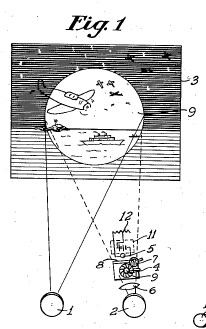
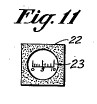
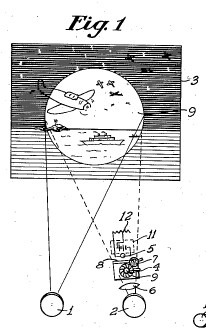
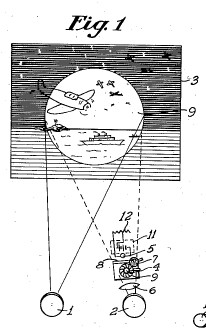
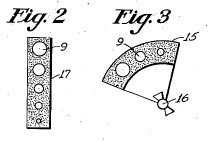
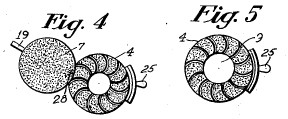
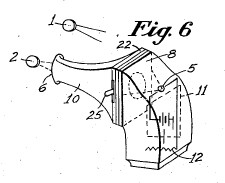
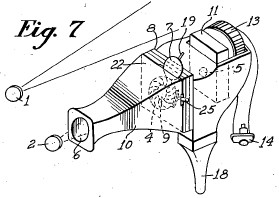
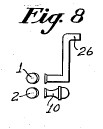
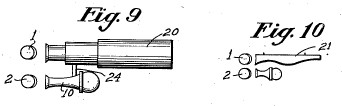
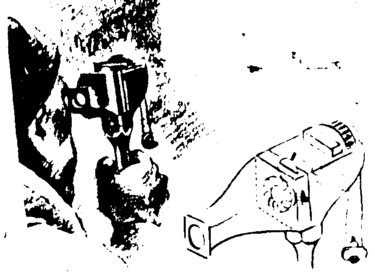
An optical aid placed before one eye that contains a small incandescent bulb, a ground-glass diffuser, and an adjustable iris diaphragm. The bulb is powered by batteries and its intensity is controlled by a rheostat. The diffuser creates a soft spot of light that can be sized and modulated, which the user perceives with the other eye, enhancing night-vision capability.
Principles
- Optical projection
- Diffusion through ground glass
- Adjustable aperture (iris diaphragm)
- Electrical brightness control (rheostat)
Scientific Domains
Materials
- Incandescent bulb (glass envelope)
- Ground glass plate
- Lens (glass)
- Metal casing
- Rheostat (resistive element)
- Batteries (3-volt cells)
- Iris diaphragm (metal/film)
- Opaque shutter (metal or painted material)
Mechanisms of Action
- Incandescent bulb illumination
- Ground-glass diffusion of light
- Iris diaphragm size variation
- Rheostat voltage regulation
Energy Sources
Applications
- Marine observation
- Air observation
- Underwater observation
- Land observation
- Dark interior viewing
- Daytime brightness enhancement
- Vision aid for impaired eyesight
Claimed Performance
Provides a controllable light spot that increases the perceptive ability of the opposite eye, allowing observation of night or darkened scenes without an external flashlight.
Limitations
- Limited by battery life and bulb brightness
- Manual adjustment required for aperture and intensity
- Potential eye strain from prolonged use
- Bulb and diffuser may degrade over time