Goal
Control gravitation and produce linear force or motion (thrust) using high-voltage electricity.
Problem
Absence of a practical method to harness gravitational energy for propulsion or power generation.
Concept Summary
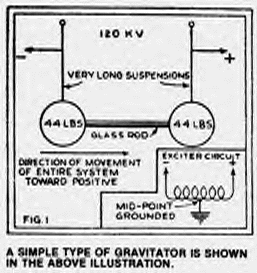
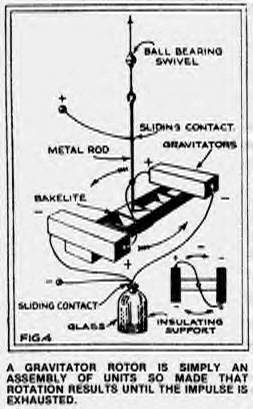
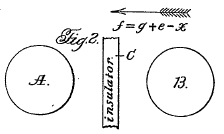
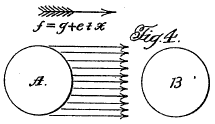
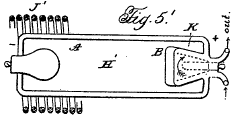
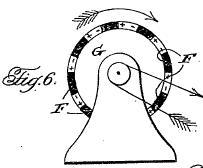
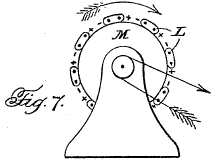
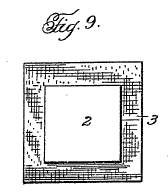
The Gravitator applies a high-voltage DC electric field to a massive dielectric (e.g., lead balls, solid dielectric blocks). The charged mass allegedly generates a unidirectional "gravitational" impulse whose duration is governed by external cosmic gravitational conditions (moon, sun, planets). The device is claimed to act as an efficient electric motor that produces thrust without conventional moving parts.
Detailed Description
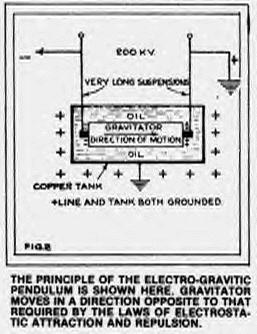
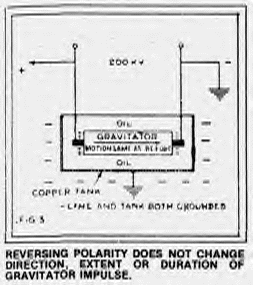
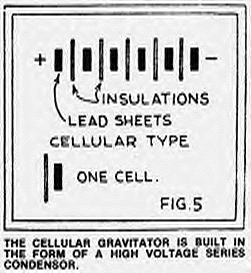
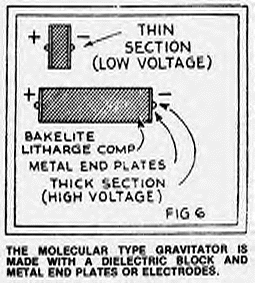
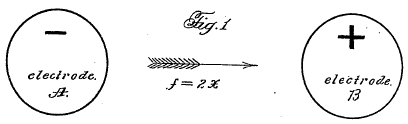
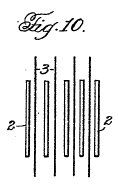
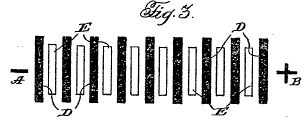
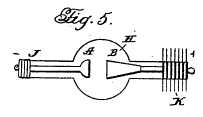
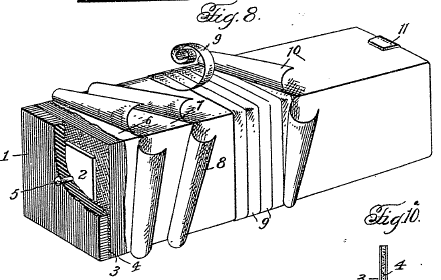
Early experiments (1924) used two oppositely charged lead balls suspended 45 cm apart; later versions employed cellular or molecular dielectric blocks immersed in oil. When a DC voltage of 75-300 kV is applied, the pendulum-type gravitator swings up, reaches a maximum amplitude in <5 s, then slowly returns to vertical over 30-80 s. The impulse duration is reported to be independent of voltage magnitude, current, or mass, and to vary with the relative positions of the Moon, Sun, and planets. The inventor describes the device as a "very efficient electric motor" that can be scaled for ships, automobiles, aircraft, and spacecraft.
Principles
- Electro-gravitation
- High-voltage electric fields
- Impulse generation governed by cosmic gravitational conditions
Scientific Domains
Materials
- Lead
- Solid dielectric blocks (massive dielectric material)
- Oil (as immersion fluid)
- Insulating members
- Metal electrodes
Mechanisms of Action
- Application of high voltage to a massive dielectric creates a unidirectional force (gravitator action)
- Impulse duration tied to external gravitational field variations
- Charge-induced interaction between electric field and mass
Energy Sources
Applications
- Propulsion for ships
- Automobile engines
- Aircraft thrust
- Spacecraft propulsion
Claimed Performance
Pendulum swings to maximum amplitude in <5 seconds, returns to vertical in 30-80 seconds; thrust claimed to be independent of voltage magnitude; potential to propel ocean liners, automobiles, aircraft, and spacecraft.
Experimental Evidence
Observations with lead balls (1924) and later cellular/molecular dielectric blocks showed motion under high voltage; impulse duration reported to correlate with lunar/solar positions; no quantitative thrust measurements provided.
Replication Status
No independent replication reported; only the inventor's own experiments are described.
Limitations
- Requires extremely high voltage (75-300 kV)
- No quantitative thrust data
- Mechanism not accepted by mainstream physics
- Lack of independent verification
Red Flags
- Extraordinary claim of free energy / overunity
- Absence of peer-reviewed data
- Qualitative description only
- Potential safety hazards from high voltage