Goal
Generate large-scale electrical power without external fuel, claiming over-unity efficiency.
Problem
Need for clean, high-output energy sources that can replace conventional fossil-fuel or nuclear power plants.
Concept Summary
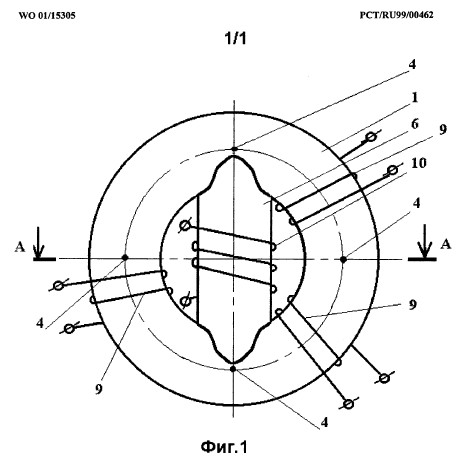
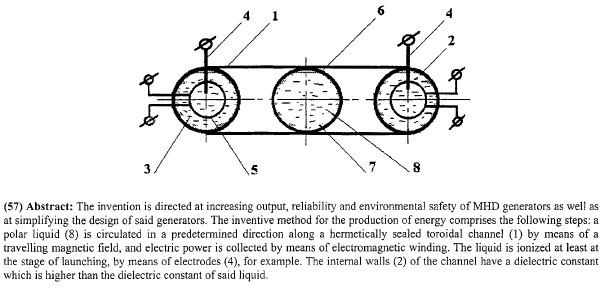
The hydro-magnetic dynamo is a sealed toroidal chamber filled with ultra-pure water (including heavy water). High-voltage capacitor discharges polarize barium-titanate crystals and ionize the water, creating an electrostatic field that, together with hydrodynamic motion of the water, allegedly triggers micro-cavity nuclear reactions (cold fusion) and cavitation-vacuum breakdowns. The resulting electrostatic transformer converts the stored charge into direct-current electricity, producing megawatt-scale power from a modest input.
Principles
- Van de Graaff-type electrostatic voltage multiplication
- Magnetohydrodynamic (MHD) amplification of stationary electromagnetic fields
- High-dielectric-constant materials (barium titanate) for charge storage
- Cold nuclear fusion / micro-cavity reactions
- Cavitation-induced vacuum breakdown
Scientific Domains
Materials
- Polystyrene (impact-resistant optic polysterol) toroid
- Ultra-pure distilled water
- Heavy water (deuterium oxide)
- Barium titanate (BaTiO_3) crystals
- Copper cooling pipes
- Capacitor banks (10 F, 100 kV)
- Lead-acid batteries
Mechanisms of Action
- High-voltage discharge polarizes BaTiO_3 crystals
- Ionized water circulates in a toroid, creating a moving conductive medium
- Electrostatic field (~10 MV/cm) is amplified by hydrodynamic motion
- Cavitation-vacuum structures break down, allegedly initiating cold fusion of deuterium
- Resulting alpha particles and free electrons produce a large DC current
Energy Sources
Applications
- Power generation for buses, trucks, ships, locomotives, airplanes
- Industrial electricity supply
- Potential grid-scale energy source
Claimed Performance
Armenian prototype produced 6 800 A at 220 V (~1.5 MW) continuously; peak output 2.5 MW; input power claimed ~=10 kW for 1 MW output (~=10 000 % efficiency); continuous operation up to 25 years with minimal maintenance.
Experimental Evidence
The author reports three prototypes built in Russia and Armenia. The third prototype (1992-1997) allegedly generated 1.5 MW continuously, with a maximum of 2.5 MW during winter cooling. The start-up used 20 kJ from 100 kV capacitors, and a battery bank sustained 14 400 W input thereafter.
Replication Status
No independent replication or peer-reviewed validation is reported; performance claims are based solely on the inventor's statements.
Limitations
- No independent verification of over-unity claims
- Requires high-voltage capacitor start-up and 400 atm pressure impulse
- Large physical size (~=2 m diameter, 900 kg)
- Unclear safety of claimed nuclear reactions
- Reliance on exotic materials (barium titanate) and precise water purity
Red Flags
- Over-unity efficiency claims without quantitative, peer-reviewed data
- Anecdotal performance statements and lack of independent replication
- Use of terms like "nuclear reaction" and "cold fusion" which are not accepted by mainstream science
- Potential high-voltage safety hazards