Goal
To create a cavity-neck system that resonates at a tunable frequency, enabling sound absorption, noise reduction, and acoustic tuning in various applications.
Problem
Undesirable low-frequency noise in engines, ducts, architectural spaces, and musical instruments; need for compact acoustic absorbers and tunable acoustic test cells.
Concept Summary
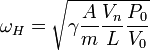
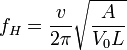
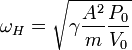
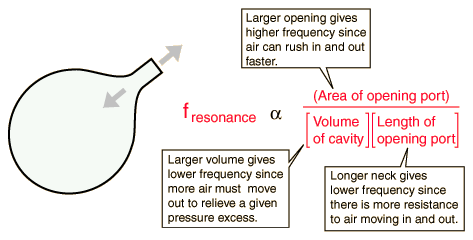
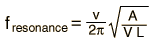
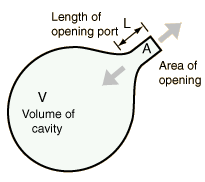
A Helmholtz resonator consists of a volume of air (the cavity) coupled to the outside through a narrow neck. The air in the neck acts as an inertial mass while the compressible air in the cavity acts as a spring. The system exhibits a resonant frequency determined by cavity volume, neck area and length, and the speed of sound. By adjusting geometry, the resonator can be tuned to target specific frequencies for noise attenuation or sound generation.
Detailed Description
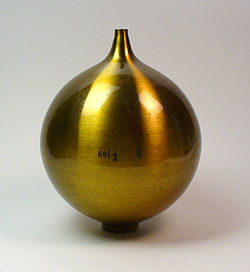
The article describes the physical principle, quantitative formulas for resonant frequency, and several practical implementations: brass spherical resonators, perforated metal sheets with honeycomb cavities for aircraft liners, automotive exhaust silencers, variable-volume resonators, and infrasonic test cells. Patents illustrate designs that place the resonator on exhaust pipes, inside intake ducts, or within acoustic materials to achieve low-frequency noise reduction or high-intensity acoustic testing.
Principles
- :Helmholtz resonance
- Mass-spring acoustic analogy
- Adiabatic compression of gas
- Acoustic impedance matching
Scientific Domains
Materials
- Brass
- Metal sheet
- Perforated metal sheet
- Honeycomb structure
- Fiber body
- Foamed body
Mechanisms of Action
- Inertial mass of air in the neck
- Spring stiffness of compressible air in the cavity
- Resonant frequency tuning via geometry (A, L, V)
- Acoustic energy dissipation through viscous and thermal losses
Applications
- Automotive exhaust noise reduction
- Aircraft engine acoustic liners
- Architectural acoustic treatment
- Musical instrument tone control
- High-intensity acoustic testing of materials
Claimed Performance
Low-frequency noise reduction in automotive exhaust systems; acoustic liners reduce engine noise; infrasonic resonators generate 6-14 Hz sinusoidal tones; drag reduction up to 40 % claimed for aircraft applications.
Experimental Evidence
Patents and product descriptions claim performance improvements (e.g., low-frequency noise abatement, 40 % drag reduction) but no peer-reviewed quantitative data are presented.
Limitations
- Performance highly dependent on precise geometry
- Limited bandwidth - effective mainly near the tuned frequency
- High-speed airflow may require additional corrections
- Manufacturing complexity for variable-volume designs