Goal
Provide more efficient radiant-energy power systems and enable high-thrust rocket propulsion by amplifying incoming radiant energy.
Problem
Low efficiency of existing radiant-energy power sources and limited thrust for propulsion systems.
Concept Summary
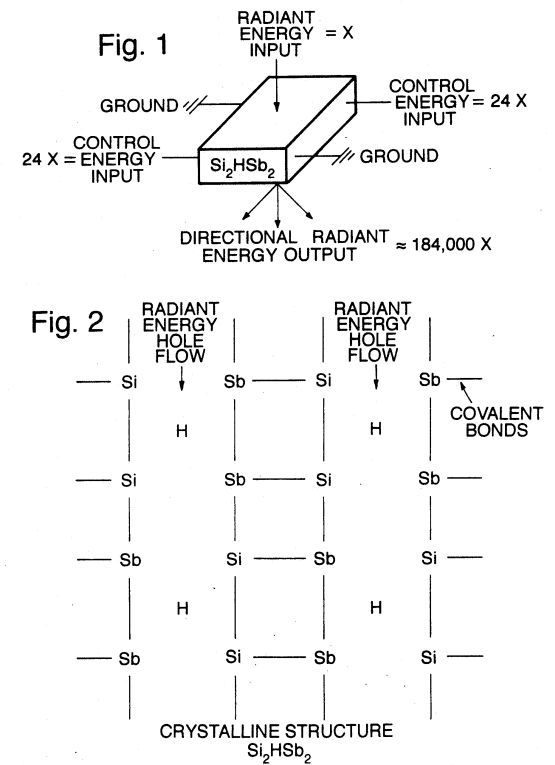
A crystalline compound Si2HSb2 contains a regular lattice of electron-deficient "holes". When radiant energy (photons, particles, etc.) strikes the top of the crystal, the holes and associated strong nuclear forces accelerate the energy as it traverses the crystal, producing an amplified output. Electrical potentials applied to side electrodes control the hole alignment, allowing the amplified beam to be steered in the x-y plane. The claimed amplification factor is about 184 000x, with control power roughly 24x the radiant input.
Principles
- Hole-mediated energy acceleration
- Strong nuclear force interaction within crystal lattice
- Electrical control of lattice holes for beam steering
Scientific Domains
Materials
- Silicon
- Antimony
- Hydrogen
- Nitric acid
- Water
- Si2HSb2
Mechanisms of Action
- Radiant energy passes through Si2HSb2 and is accelerated by electron-deficient holes
- Applied side potentials align holes and direct the amplified output
- Nuclear forces within the lattice provide additional energy gain
Energy Sources
Applications
- Rocket propulsion
- High-power laser systems
- Spacecraft power and thrust
Claimed Performance
184,000x power amplification; control power ~= 24x radiant input power.
Limitations
- Potential overheating and melting under high-energy input
- No published experimental data or independent verification
- Requires large control power relative to input
- Durability under prolonged nuclear-force interaction not demonstrated
Red Flags
- Extraordinary energy-amplification claim without empirical evidence
- Apparent violation of conservation of energy
- Use of unverified strong-nuclear-force mechanism