Goal
Generate extremely high-voltage pulses to produce electrostatic thrust for levitation and propulsion (e.g., flying saucer).
Problem
Conventional propulsion systems cannot achieve silent, high-speed lift-off without large masses or fuel; need a compact source of very high voltage pulses.
Concept Summary
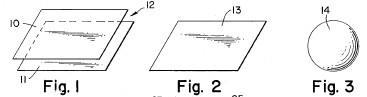
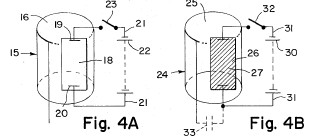
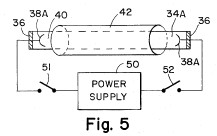
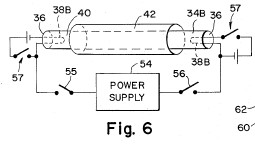
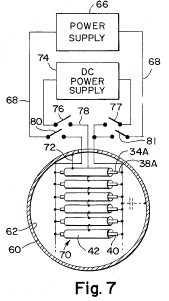
The Capacity Changer converts a conventional two-terminal capacitor into a one-terminal capacitor by extinguishing a plasma stream inside a glass tube. The plasma acts as the disappearing terminal; when it is removed, the remaining metal sphere becomes a single-terminal capacitor whose capacitance is far smaller, causing the voltage to rise proportionally (C/c x V). Repeated rapid conversion produces momentary high-voltage pulses that can repel the sphere from the ground and provide thrust.
Principles
- Capacitance conversion (C to c)
- Electrostatic repulsion
- Plasma discharge as temporary terminal
- Rapid switching of capacitor terminals
Scientific Domains
Materials
- Glass tube (ultraviolet light tube)
- Metal sphere (~=2 m diameter)
- Copper wiring
- Switches
Mechanisms of Action
- Charge redistribution when one terminal is removed
- Voltage amplification due to reduced capacitance
- Pulse generation via fast switching
Energy Sources
Applications
- Propulsion of vehicles (flying saucer, VTOL)
- High-voltage pulse generation
- Potential power generation from ambient fields
Claimed Performance
Momentary pulses of 20 000 - 100 million volts; lift-off of a sphere; propulsion to moon in hours (theoretical).
Experimental Evidence
Author reports zapping nearby Hi-Fi equipment, generating three 500 kV pulses, and causing a power transformer to blow when the device was connected to ground.
Replication Status
No independent verification; only anecdotal reports by the inventor.
Limitations
- Requires extremely high voltage and rapid switching
- No peer-reviewed experimental data
- Safety hazards from uncontrolled discharges
Red Flags
- Grandiose claims (e.g., moon in three hours)
- Lack of independent testing or peer-reviewed publications
- Anecdotal evidence only