Goal
To discover and harness a newly described form of energy (eloptic) for non-destructive material analysis and other potential applications.
Problem
Absence of a universal, non-destructive method to determine the composition of unknown materials without altering them.
Concept Summary
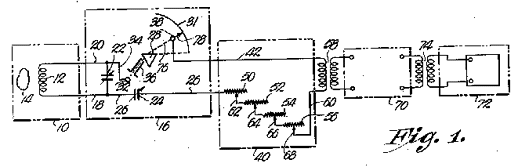
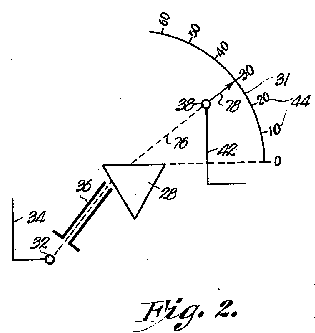
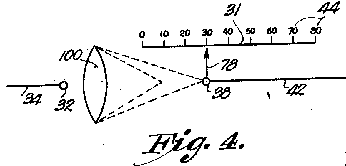
The article proposes the existence of a pervasive 'Fine Media' (akin to ether) that can be set into oscillation at specific frequencies. When properly excited-by mental-emotional output, particles, or other means-this media emits 'eloptic radiation' whose frequency is characteristic of the emitting element or compound. By detecting and analyzing these frequencies, one could identify material composition without physical disturbance.
Principles
- Fine Media (ether) oscillation at characteristic frequencies
- Resonant energy absorption and emission by atomic nuclei
- Conversion of mental-emotional output into oscillatory energy
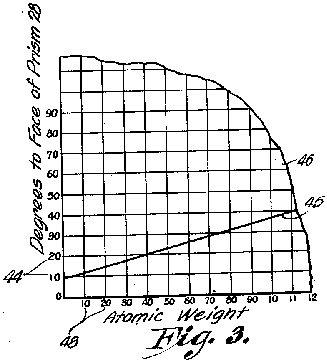
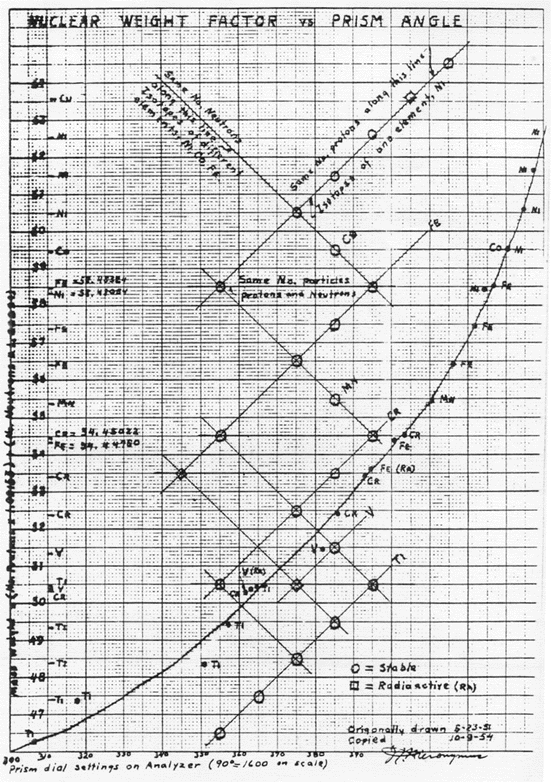
- Frequency-based identification of elements and compounds
Scientific Domains
Mechanisms of Action
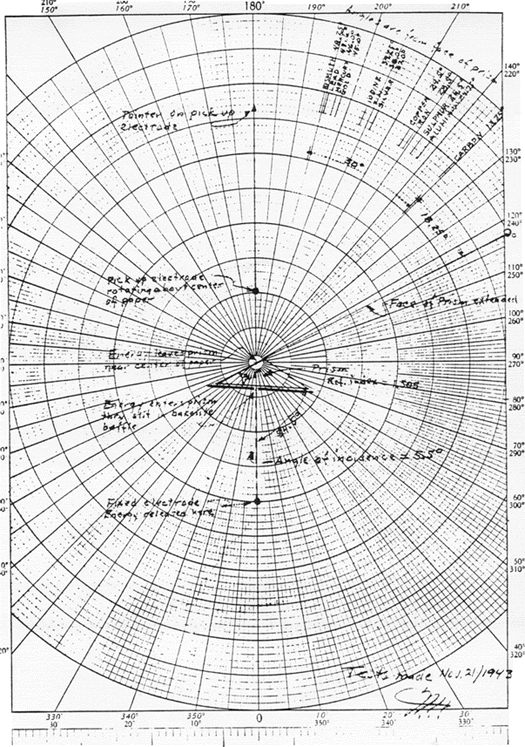
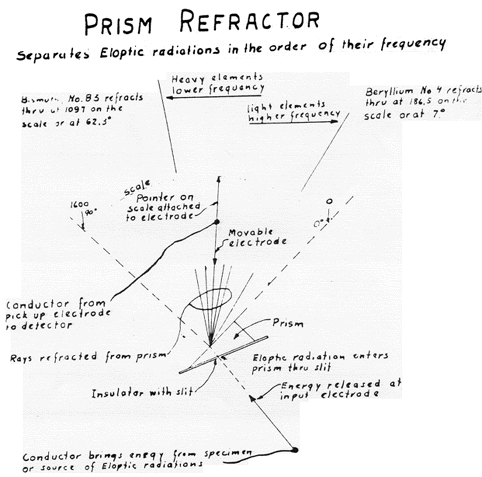
- Emission of eloptic radiation from elements based on their nuclear frequency
- Resonant excitation of the Fine Media using low-energy, correctly-tuned inputs
- Detection of emitted frequencies to infer material composition
Energy Sources
Applications
- Material composition analysis
- Non-destructive testing
- Potential energy generation (speculative)
Claimed Performance
Ability to determine the contents of an unknown material by analyzing its eloptic radiation without destroying or disturbing the object.
Limitations
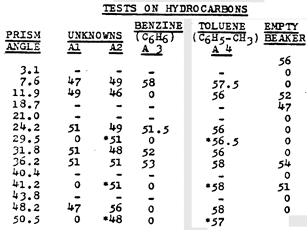
- No quantitative experimental data provided
- Reliance on undefined mental-emotional energy as a trigger
- Conceptual nature of the Fine Media lacks peer-reviewed validation
Red Flags
- Extraordinary claims of a new fundamental energy without empirical evidence
- Use of vague concepts such as 'mental-emotional output' and 'Fine Media'
- Absence of reproducible experimental data or peer-reviewed studies