Goal
Provide a low-power, simple propulsion method for toy boats and model aircraft that mimics the efficient tail-flapping of fish and wing-flapping of birds.
Problem
Inefficiency of clock-work propellers that require large springs and are difficult to wind, limiting run time and simplicity for small watercraft and model planes.
Concept Summary
A vibrating flexible tail (fishtail) is driven by an electromagnet buzzer powered by dry-cell batteries (or manual pumping). The oscillating foil creates thrust through rapid back-and-forth motion, allowing small boats and model aircraft to move forward with minimal energy input.
Detailed Description
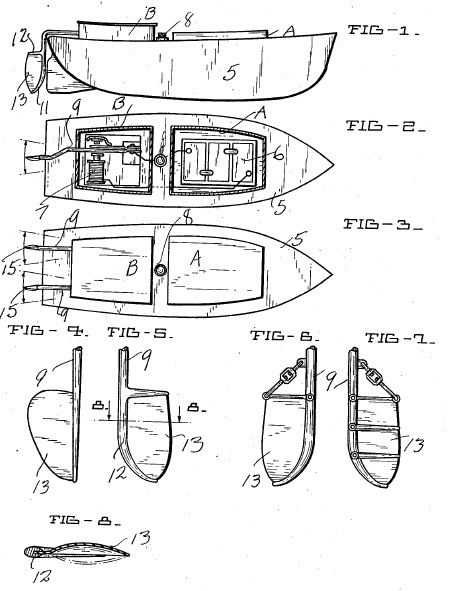
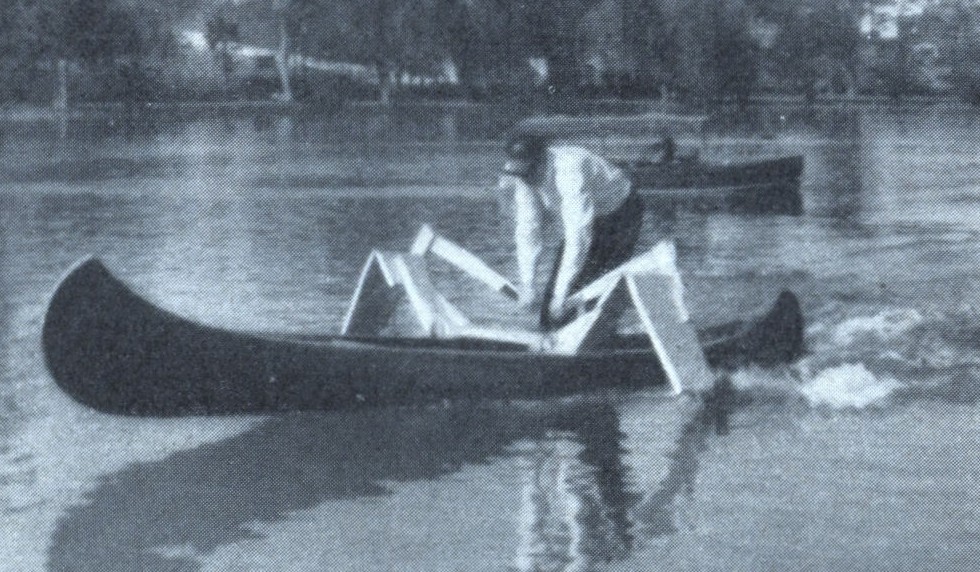
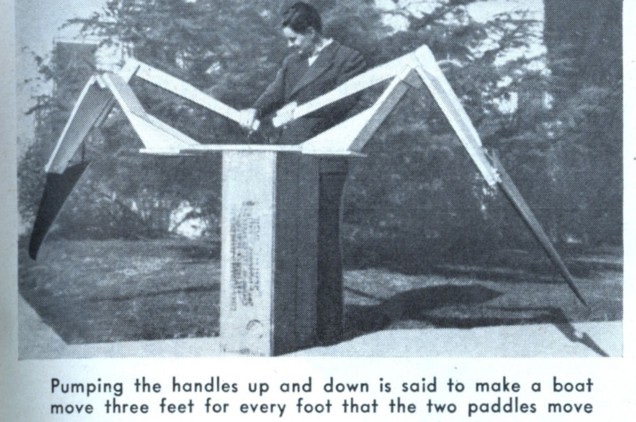
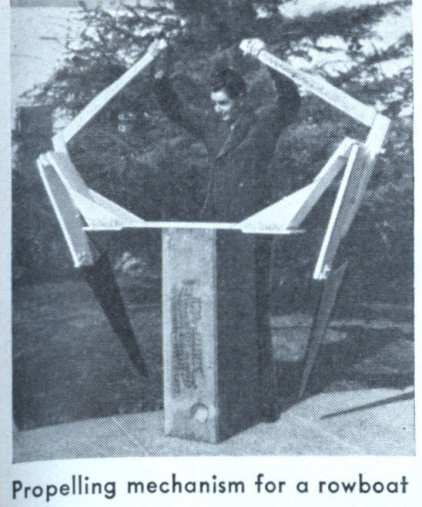
The invention comprises a hull containing a dry-cell battery and an electromagnet buzzer. The buzzer's clapper extends outward and is bent to form a curved, flexible flap (the fishtail). When the buzzer is activated, the clapper vibrates, causing the flap to oscillate like a fish tail. The flexible flap is mounted on a supporting rod with a sharp leading edge and a tapered trailing edge. Adjustments to the sag of the flap are made via a turnbuckle or additional pivoted arms, allowing control of thrust magnitude. For larger craft the flap is made of linen coated with creosote; for toys it is wood and silk. The device can also be powered manually by pumping a handle up and down, converting human motion into the same vibratory action.
Principles
- Oscillating foil thrust (hydrodynamic/aerodynamic lift generated by rapid side-to-side motion)
- Pendulum spring action of the clapper to amplify motion
- Conversion of electrical energy from dry-cell batteries into mechanical vibration
Scientific Domains
Materials
- wood
- silk
- linen
- creosote
Mechanisms of Action
- Vibrating flexible tail creates thrust by periodically changing angle of attack
- Electromagnetic buzzer drives clapper oscillation
- Manual pumping translates linear motion into oscillatory motion
Energy Sources
Applications
- Toy boats
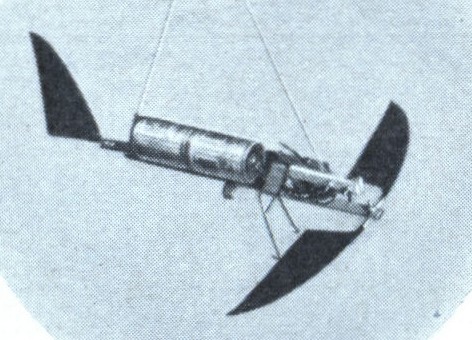
- Model airplanes
- Small personal watercraft
Claimed Performance
The device is said to drive a boat forward three feet for every foot the power device moves.
Experimental Evidence
Demonstrated on toy boats and model airplanes; the craft moved forward when the buzzer was powered, and the vibrating wings became invisible due to high speed. No quantitative performance data were provided.
Limitations
- Requires a battery or manual pumping for operation
- No quantitative efficiency data
- Scalability limited by material strength and flap size