Goal
Convert waste plastics into drop-in diesel fuel
Problem
Large volumes of plastic waste polluting oceans and landfills, and lack of efficient recycling pathways
Concept Summary
A mobile, small-footprint reactor uses a metallocene-based catalyst deposited on a porous support with a reducing metal component (Fe, Ni, Pd, Pt) to perform continuous-feed pyrolysis of polyethylene, polypropylene, and polystyrene. The catalyst enables direct formation of diesel-range hydrocarbons (C4-C40) without downstream refining, allowing scalable conversion of plastic waste into usable fuel.
Detailed Description
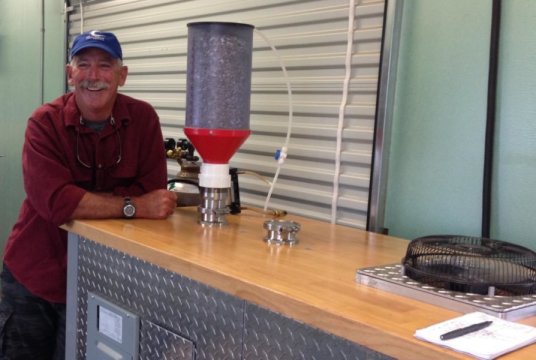
The patented system comprises a porous support (average pore size ~10 Angstrom) bearing an exterior-surface depolymerization catalyst (metallocene or Ziegler-Natta type) and a reducing catalyst component within the pores. Plastic feedstock is fed continuously into the reactor, where controlled heating (pyrolysis) in the presence of the catalyst breaks polymer chains into hydrocarbons that fall within the diesel fuel range. The reactor can be housed in a 20-foot shipping container or mounted on a flat-bed truck, enabling on-site processing of 200 lb to >10,000 lb of plastic per 10-hour day.
Principles
- Catalytic depolymerisation
- Pyrolysis
- Metallocene catalysis
- Continuous-feed processing
Scientific Domains
Materials
- Porous support (e.g., silica, alumina)
- Metallocene catalyst
- Reducing metal (Fe, Ni, Pd, Pt)
- Polyethylene
- Polypropylene
- Polystyrene
Mechanisms of Action
- Catalyst-mediated cleavage of polymer chains to hydrocarbons
- Reduction of metal catalyst within pores to promote selective cracking
Energy Sources
Applications
- Fuel production from waste plastics
- Plastic waste remediation
Claimed Performance
Direct production of diesel fuel without further refining; scalable throughput from 200 lb to >10,000 lb of plastic per 10-hour day; operation within a 20-foot container or truck-mounted unit.
Experimental Evidence
The article reports laboratory development and plans a demonstration project for the city of Santa Cruz, but provides no quantitative performance data.
Limitations
- No peer-reviewed quantitative data yet
- Long-term catalyst durability not demonstrated
- Scale-up and economic analysis pending
Red Flags
- Claims are based on planned demonstrations rather than completed trials
- Lack of independent verification or peer-reviewed publications