Goal
Provide underwater communication without cables by transmitting electromagnetic radiation through water.
Problem
Lack of reliable, long-range communication between ships, submarines and other submerged platforms.
Concept Summary
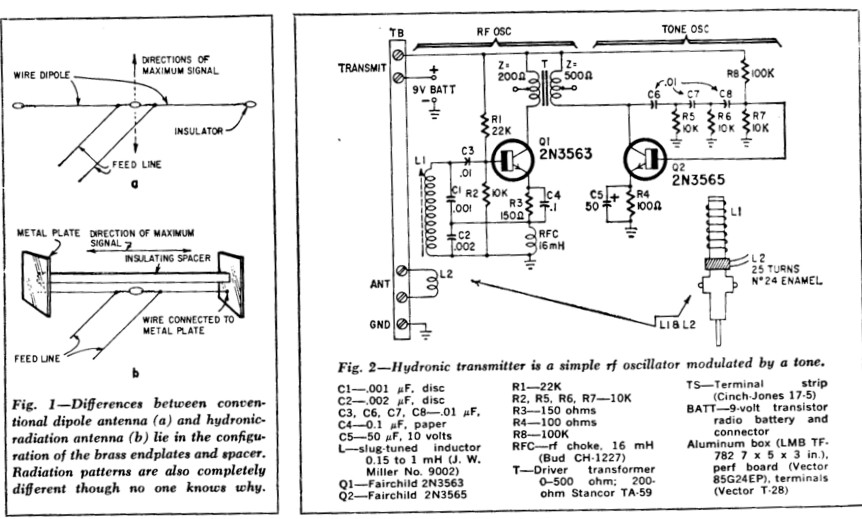
A low-power RF transmitter (powered by a 9-V battery) is coupled to a pair of large brass plate antennas separated by an insulating spacer. The plates make direct contact with water, allowing the RF field to propagate through the water medium. The system is claimed to work like conventional radio but with water as the propagation medium, enabling communication distances from a few hundred feet up to tens of miles.
Detailed Description
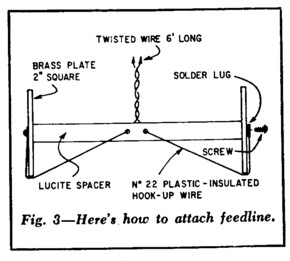
The transmitter consists of a standard AM broadcast-band oscillator (Q1) tuned by a 25-turn coil (L1) and an audio oscillator (Q2) that modulates the RF carrier at ~1 kHz via a transformer. The circuit is housed in a small aluminum box and powered by a 9-V transistor-radio battery. Two identical plate antennas (~=2 in^2 brass plates) are mounted on a non-conductive spacer (bakelite, lucite, etc.) and connected to the transmitter and a modified transistor-radio receiver via balanced feed lines. Experiments described include bathtub tests, directional pattern tests, and "up-over-down" surface-wave tests, with reported signal frequencies shifting to ~700 kHz when immersed. The author reports successful transmission distances up to 30 miles in salt water and 100 ft with a 6-ft plate spacing.
Principles
- electromagnetic radiation
- magnetohydrodynamic coupling
- RF oscillation
- plate-type antenna coupling
Scientific Domains
Materials
- brass
- bakelite
- lucite
- plastic-insulated copper wire
- enamelled wire (No. 24)
- aluminum
Mechanisms of Action
- RF field radiated through water via conductive plate antennas
- possible surface-wave propagation (up-over-down)
- dipole effect of connecting wires
Energy Sources
Applications
- ship-to-ship communication
- submarine communication
- cable-free trans-Atlantic links
Claimed Performance
Signals transmitted up to 30 miles in salt water; 100 ft+ range with 6-ft plate spacing; tone-modulated carrier observed at 550-800 kHz (shifts to ~700 kHz when immersed).
Experimental Evidence
Author-reported bathtub and open-water tests using a simple receiver; observed tone disappearance when receiver removed from water; directional attenuation observed when antennas rotated; signal strength reduced with deeper submersion.
Replication Status
Only author-reported experiments; no independent verification or commercial scaling mentioned.
Limitations
- Unclear physical mechanism
- Limited range without large plate spacing
- Signal attenuation with depth
- No peer-reviewed validation
Red Flags
- Extraordinary distance claim (30 miles) without quantitative data
- Lack of independent replication
- Potential sensationalism in original publication