Goal
Prevent highly contaminated radioactive water from leaking into the sea by creating an impermeable barrier in trench walls.
Problem
Leakage of radioactive water from the Fukushima Daiichi nuclear plant into the ocean.
Concept Summary
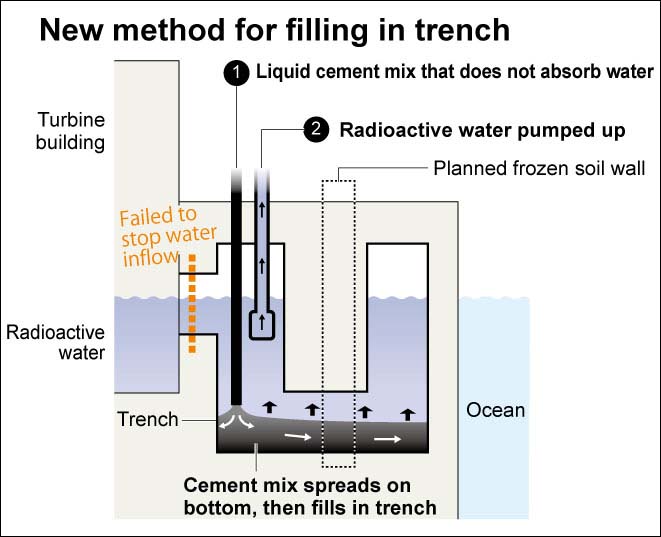
A cement-based mixture treated with hydrophobic agents (e.g., hydrophobic limestone powder, organosilicon monomers, silicone grease) that does not absorb water, allowing it to spread easily along trench bottoms and displace contaminated water, thereby sealing the trench and limiting diffusion of radionuclides.
Detailed Description
The article describes TEPCO's plan to inject a special hydrophobic cement mixture into seaside trenches of reactors No. 2 and No. 3. The mixture's water-repellent properties enable it to spread and displace tainted water, keeping radioactive materials in the surrounding soil. Several patents are listed that detail methods for constructing semi-basements for radioactive waste, radiation-chemical treatment of cement bricks, plugging fluids for subterranean formations, and various hydrophobic cement formulations using organosilicon monomers, silicone greases, and solid silicates. The technology is positioned as a waterproofing and radiation-shielding solution for nuclear waste containment and underground construction.
Principles
- Hydrophobicity
- Water-repellent coating
- Impermeability
- Radiation shielding
Scientific Domains
Materials
- Portland cement
- Hydrophobic limestone powder
- Organosilicon monomer (vinylheptamethylcyclotetrasiloxane)
- Polymethylsiloxane liquid
- Silicone grease
- Solid silicate or metasilicate
- Clay
- Hydraulic cement
Mechanisms of Action
- Hydrophobic coating prevents water absorption by cement particles
- Creates a barrier that displaces contaminated water
- Immobilizes radionuclides within the sealed trench
- Provides additional radiation shielding through hydrophobic limestone powder
Applications
- Sealing of underground trenches at nuclear sites
- Containment of radioactive waste
- Water-proofing of underground structures
Claimed Performance
The special mixture does not absorb water, allowing it to spread more easily along the trench bottom and displace tainted water, thereby preventing massive amounts of highly contaminated water from leaking into the ocean.
Experimental Evidence
The article reports that TEPCO plans to inject the mixture and that previous attempts with freezing and standard cement were insufficient, but it provides no quantitative performance data.
Limitations
- Effectiveness not quantified in the article
- Long-term durability under seismic activity unknown
- Requires proper mixing and application techniques