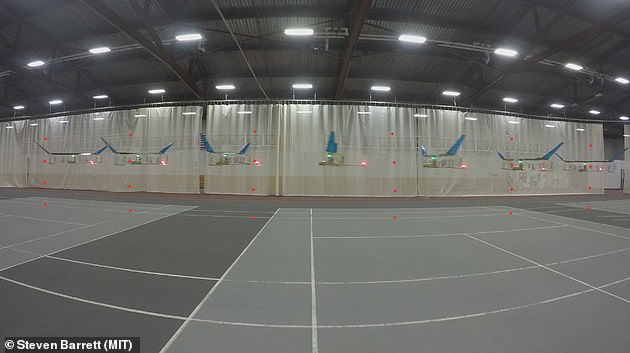
Goal
Provide silent, emission-free flight using solid-state ionic-wind propulsion, eliminating propellers and turbines.
Problem
Noise, greenhouse-gas emissions, and mechanical complexity of conventional aircraft propulsion.
Concept Summary
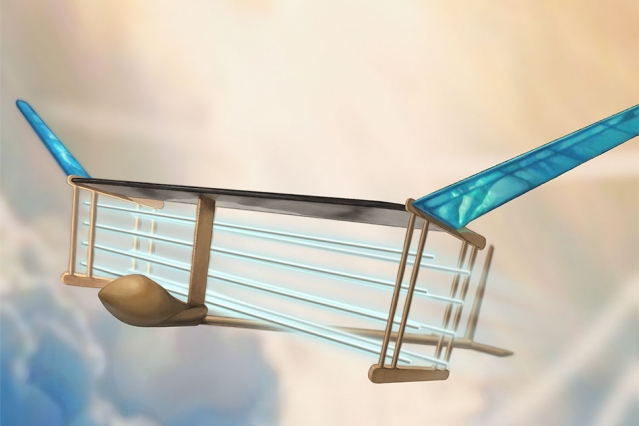
A lightweight fixed-wing glider equipped with high-voltage electrodes that ionize ambient air. The resulting ionic wind transfers momentum to the surrounding air, generating thrust without any moving parts.
Detailed Description
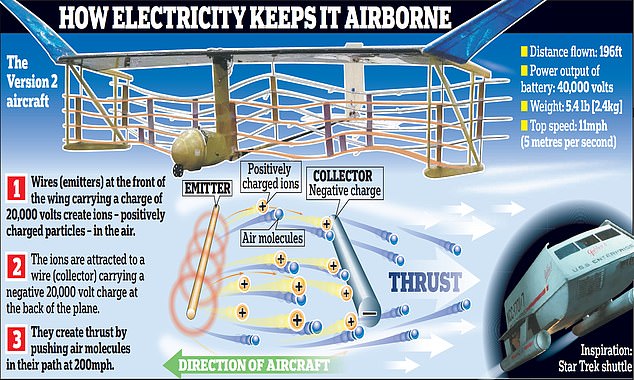
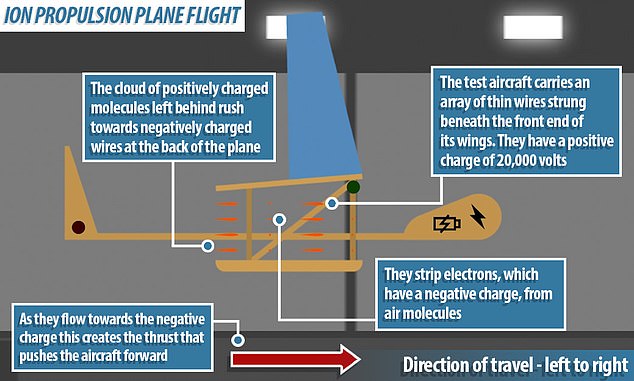
The aircraft carries an array of thin conductive wires beneath the leading edge of the wings, charged to ~20 kV (up to 40 kV in later tests). The positive voltage strips electrons from air molecules, creating positively charged ions that accelerate toward negatively charged wires at the trailing edge. Collisions between these ions and neutral air molecules produce a steady "ionic wind" that pushes the craft forward. All power electronics, including a lightweight high-voltage converter, are battery-powered and carried on-board. Test flights demonstrated sustained, low-altitude glide of 60 m in an indoor gymnasium.
Principles
- Electroaerodynamics
- Ion wind (ionic wind) thrust
- Coulomb force
- Momentum transfer from ions to neutral air
Scientific Domains
Materials
- Copper wire (thin electrodes)
- Lightweight lithium-polymer battery
- High-voltage power converter (silicon MOSFETs, transformer)
- Air (ambient fluid)
Mechanisms of Action
- High-voltage electrode ionization of air
- Acceleration of ions by electric field
- Collision-based momentum transfer to neutral air molecules
Energy Sources
Applications
- Quiet drones
- Hybrid passenger aircraft
- Low-noise urban air mobility
Claimed Performance
Sustained flight of 60 m (197 ft) at an average height of 0.47 m (18 in) with a 5-lb (2.3 kg) aircraft; thrust generated by 20-40 kV electrode array.
Experimental Evidence
Demonstrated in MIT laboratory (gymnasium) and reported in Nature (2018) and MIT News; video documentation available on YouTube; peer-reviewed IEEE paper on high-voltage converter.
Replication Status
Demonstrated by MIT researchers; no independent third-party replication reported in the article.
Limitations
- Requires very high voltage (20-40 kV) from lightweight battery
- Low thrust-to-power ratio limits payload and altitude
- Current demonstrations limited to indoor, low-altitude flight