Goal
To produce materials whose gravitational mass differs from their inertial mass (gravitationally-anomalous isotopes).
Problem
Conventional separation methods cannot distinguish particles that have identical inertial mass but different gravitational mass.
Concept Summary
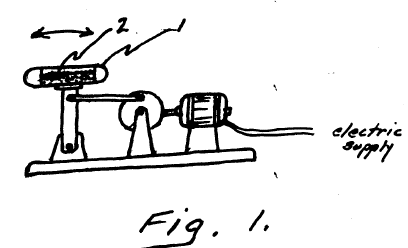
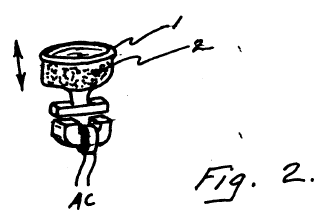
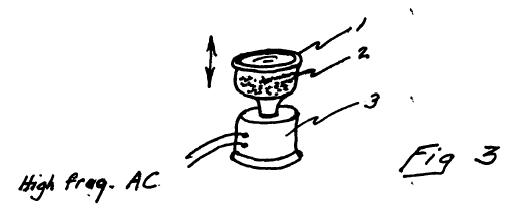
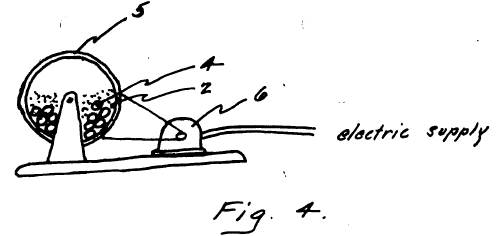
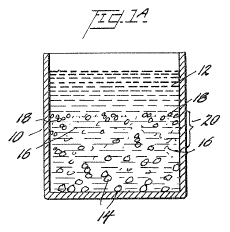
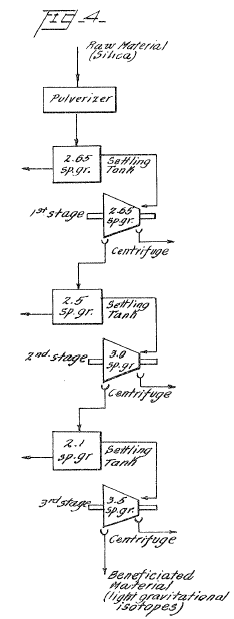
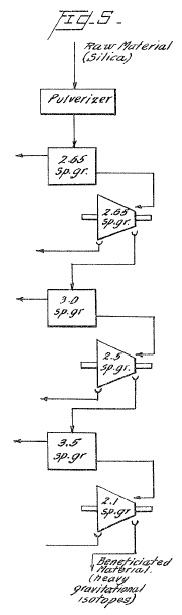
The invention separates gravitational isotopes by alternating settling in fluids of specific densities and high-speed centrifuging, exploiting differences in weight-to-mass ratios. Materials that are slightly lighter or heavier gravitionally than the bulk settle or float differently under centrifugal force, allowing their isolation.
Principles
- Differential centrifugal hydrometry
- Buoyancy balancing between gravitational and inertial forces
- Non-equivalence of gravitational and inertial mass
Scientific Domains
Materials
- Silica (cristobalite, tridymite, quartz, silver sand, vitreous silica)
- Thallium formate
- Thallium malonate
- Acetylene tetrabromide
- Water
- Ether
- Alcohol
Mechanisms of Action
- Separation based on weight-to-mass ratio differences
- Use of fluids with tuned density to create buoyant equilibrium
- Centrifugal forces to unbalance fractions that deviate from unity
Applications
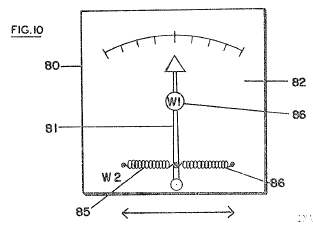
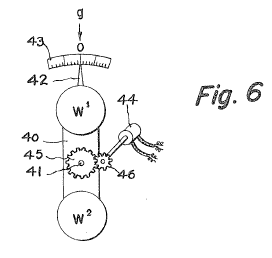
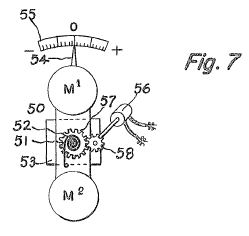
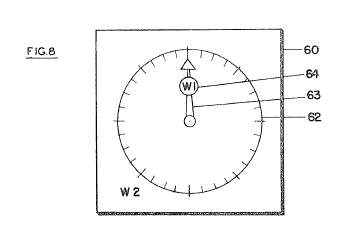
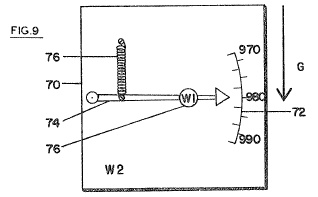
- Gravity-sensitive control devices
- Inertial-sensitive control devices
- Aerial navigation and missile guidance
Claimed Performance
Materials with weight-to-mass ratios significantly different from unity; temperature deviation of 0.002-0.005 deg C relative to ambient; ability to produce gravity-sensitive control elements.
Experimental Evidence
Observed spontaneous evolution of energy (light, heat) from lighter-isotope materials and continuous heat absorption by heavier-isotope materials; measured temperature differences of 0.002-0.005 deg C.
Limitations
- Requires high-density, potentially toxic fluids
- Very small fractions of isotopes; low overall yield
- No independent peer-reviewed validation
Red Flags
- Violates the equivalence principle of general relativity
- Lack of quantitative data and independent replication
- Use of hazardous chemicals (thallium compounds) without safety details