Goal
Disinfect and sterilize root canals and dental biofilms using a non-thermal plasma plume.
Problem
Persistent bacterial biofilm infections in root canals that resist conventional antibiotics and sterilization methods.
Concept Summary
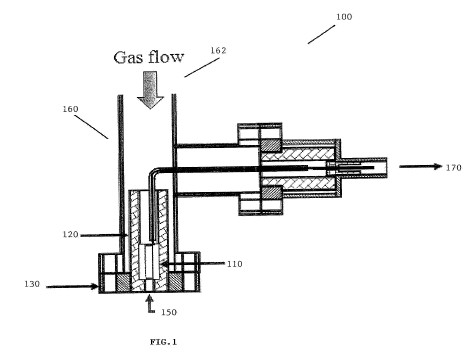
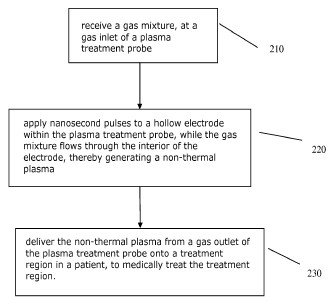
A handheld probe generates a room-temperature, atmospheric-pressure plasma by applying nanosecond high-voltage pulses to a hollow metallic electrode while a helium-oxygen gas mixture flows through it. The resulting plasma plume contains reactive atomic oxygen radicals that disrupt bacterial membranes, achieving rapid biofilm removal without significant heating.
Detailed Description
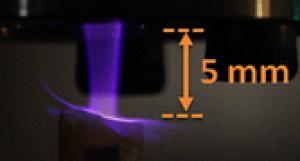
The probe consists of a hollow tubular electrode (brass or stainless steel) surrounded by a ceramic insulating tube and an outer gas-tight chamber. A high-voltage pulse generator delivers 50-100 ns pulses up to 10 kV at up to 3 kHz. Helium with <1 % O_2 is fed at 1-10 SLM, producing a pencil-like plasma plume 2-3 cm long. Laboratory tests on extracted human teeth showed <5 deg C temperature rise after 10 min exposure and 100 % killing of Staphylococcus, Streptococcus, and Bacillus atrophaeus on agar plates. The device can be touched safely and is intended for root-canal sterilization, dentin tubule cleaning, wound disinfection, and implant sterilization.
Principles
- Non-thermal plasma generation
- Nanosecond high-voltage pulsed discharge
- Reactive oxygen species (atomic oxygen) bactericidal action
Scientific Domains
Materials
- Brass
- Stainless steel
- Ceramic
- Copper gaskets
- Torr-seal glue
- Helium
- Oxygen
Mechanisms of Action
- Generation of reactive oxygen radicals
- Disruption of bacterial cell membranes
- Physical removal of biofilm matrix
Energy Sources
Applications
- Root canal sterilization
- Dental biofilm removal
- Wound disinfection
- Implant sterilization
Claimed Performance
100 % killing of test organisms on nutrient agar; temperature rise of only ~5 deg C after 10 min exposure; average power consumption <2 W; plasma plume length 2-3 cm.
Experimental Evidence
Scanning electron microscope images showed near-pristine tooth surfaces after plasma treatment; laboratory experiments reported 100 % killing of Staphylococcus, Streptococcus, and Bacillus atrophaeus; temperature sensors recorded <=5 deg C increase during 10 min exposure.
Replication Status
Preliminary laboratory experiments only; no independent replication reported.
Limitations
- Requires supply of helium/oxygen gas mixture
- Limited to surface or near-surface treatment
- Needs high-voltage pulsed power source
Red Flags
- Data limited to preliminary laboratory tests
- No clinical trial results reported