Confidence
0.85
Practicability
0.60
Evidence
0.40
Fringe Score
0.20
Risk
0.10
TRL
6
Goal
Reduce hull friction to lower fuel consumption and CO_2 emissions of large vessels.
Problem
High fuel costs and greenhouse-gas emissions of container and tanker ships.
Concept Summary
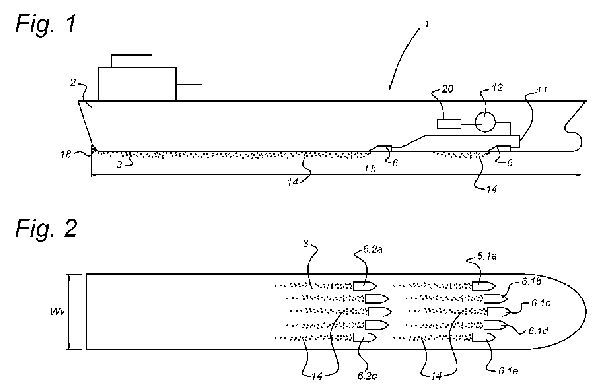
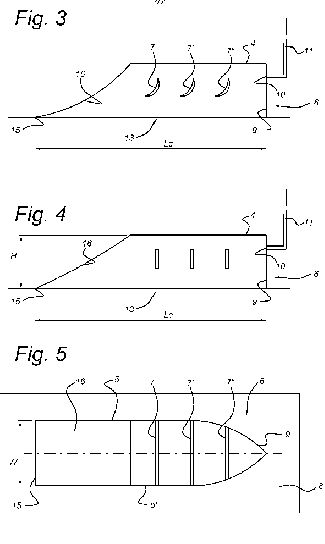
A cavity built into the hull of a displacement vessel is supplied with a controlled airflow. The moving vessel creates a Kelvin-Helmholtz instability at the air-water interface, generating a stable layer of micro-bubbles that act as a lubricating film beneath the hull, thereby reducing hydrodynamic drag.
Principles
- Kelvin-Helmholtz instability
- Micro-bubble drag reduction
- Air-lubrication layer
Scientific Domains
Materials
- steel
- air
Mechanisms of Action
- Air injected into a shallow cavity creates a high-velocity air-water interface
- Instability mixes air and water, forming a durable micro-bubble layer
- Bubble layer reduces skin friction on the hull
Energy Sources
Applications
- large container ships
- oil tankers
Claimed Performance
10-15 % reduction in propulsion energy use, 9 000 t oil saved per year for an 11-13 000 TEU vessel, 36 000 t CO_2 reduction, repayment period ~=2.5 years.
Experimental Evidence
Company estimates of oil and CO_2 savings; no independent test data presented.
Limitations
- Requires hull modification and integration of air-compression system
- Air-compressor power consumption offsets some savings
- Performance depends on vessel speed and sea state
Red Flags
- Performance figures are based on internal estimates, not peer-reviewed data
- No independent replication or sea-trial results reported