Goal
Harvest ocean thermal energy to power autonomous underwater vehicles for virtually indefinite operation.
Problem
Limited endurance of underwater vehicles and buoys due to finite battery life; need a renewable, self-sustaining power source.
Concept Summary
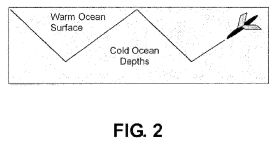
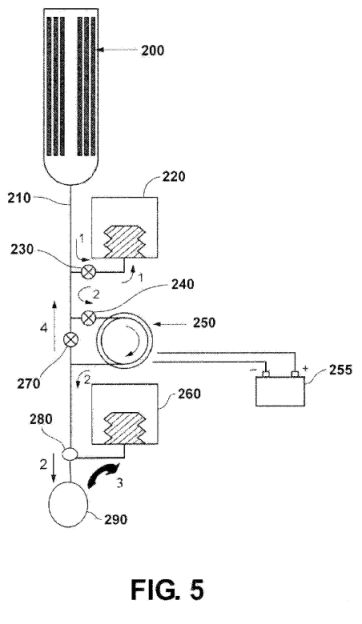
The vehicle contains tubes filled with a wax-based phase-change material (PCM). When the vehicle rises into warm surface water the PCM melts and expands, pressurizing oil that drives a hydraulic motor to generate electricity and recharge batteries. When the vehicle dives into cold water the PCM solidifies and contracts, allowing the oil to be drawn back, changing buoyancy and repeating the cycle.
Detailed Description
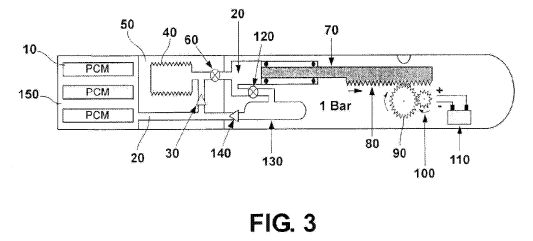
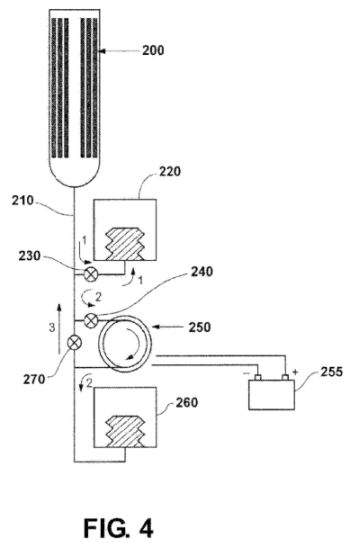
SOLO-TREC uses ten external tubes packed with waxy PCM. Warm surface water causes the PCM to melt, expanding and forcing oil into a high-pressure bellows. The pressurized oil powers a hydraulic motor coupled to a generator, producing electricity that charges onboard batteries. The batteries power a hydraulic system that adjusts the float's volume, providing buoyancy control for vertical movement. When the vehicle descends into colder water the PCM solidifies, contracting and drawing oil back into the low-pressure chamber, ready for the next cycle. Over 300 dives (surface to 500 m) have been completed, yielding ~1.7 Wh (~=6 kJ) per dive, sufficient for scientific instruments, GPS, communications, and buoyancy pumps.
Principles
- Phase-change material expansion/contraction
- Hydraulic pressure conversion
- Buoyancy control via volume change
- Thermal gradient energy harvesting
Scientific Domains
Materials
- wax phase-change material
- hydraulic oil
- nitrogen gas (for bellows)
- metal bellows
Mechanisms of Action
- PCM melts in warm water -> expands -> pressurizes hydraulic fluid
- Pressurized fluid drives hydraulic motor -> generator -> electricity
- Electricity charges batteries
- Battery-powered hydraulic system changes vehicle buoyancy
Energy Sources
Applications
- Long-duration ocean monitoring
- Climate and marine biology research
- Naval surveillance
- Submersible vehicle power
Claimed Performance
~=1.7 Wh (~=6 100 J) of electricity per dive, enough to run onboard science instruments, GPS, communications, and buoyancy-control pump.
Experimental Evidence
Prototype (84 kg) completed >300 dives from surface to 500 m off Hawaii; each dive generated ~1.7 Wh; system operated for months in an extended mission.
Replication Status
Demonstrated prototype by NASA JPL, Scripps Institution of Oceanography, and Office of Naval Research; field-tested but not yet commercialized.
Limitations
- Low power output (~=1.7 Wh per dive)
- Dependence on sufficient temperature gradient
- Complex hydraulic plumbing
- Scalability to larger platforms not yet demonstrated
Red Flags
- Claims of "virtually indefinite" operation rely on continuous thermal gradients; real-world variability may limit performance.