Goal
Provide compact, high-power, flexible on-chip energy storage for miniaturized electronics.
Problem
Conventional micro-fabrication of supercapacitors is costly and cumbersome, limiting widespread adoption of on-chip energy storage.
Concept Summary
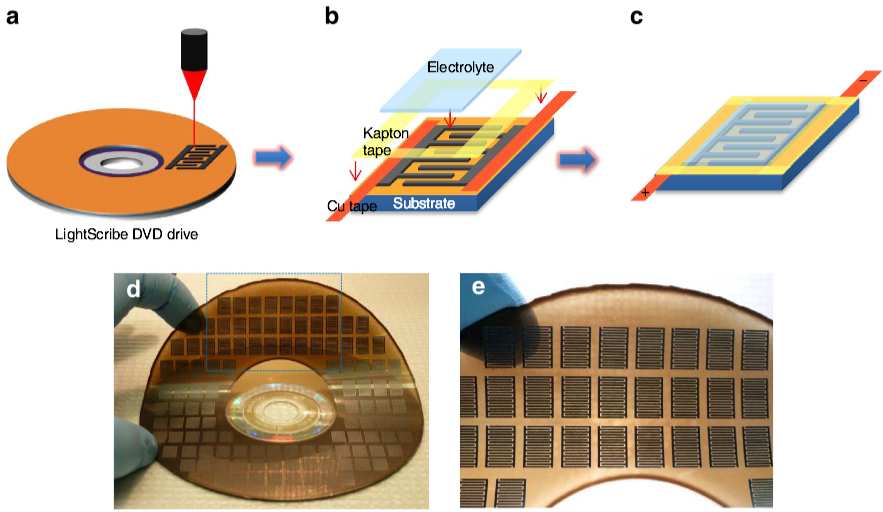
A LightScribe DVD burner laser directly writes inter-digitated graphene patterns onto graphite-oxide films, converting them to laser-sinter graphene (LSG). The resulting planar micro-supercapacitor is built on flexible PET, coated with a solid-state electrolyte (PVA-H_2SO_4 or ionogel), and can be fabricated in large numbers on a single disc in <30 min. The devices exhibit high volumetric power density (~200 uW cm^-^3), excellent cycling stability, and mechanical flexibility.
Detailed Description
The process starts with a graphite-oxide (GO) dispersion coated on a PET sheet, which is adhered to a DVD disc. In a LightScribe optical drive, a computer-designed pattern is laser-etched; the laser thermally reduces GO to conductive graphene (LSG) at precise locations, forming inter-digitated electrode fingers (150 um spacing). Copper tape provides edge contacts and Kapton tape defines the active area. An electrolyte overcoat (either PVA-H_2SO_4 gel or an ionogel made from 1-butyl-3-methylimidazolium bis(trifluoromethylsulfonyl)imide and fumed silica) completes the planar micro-supercapacitor. Devices retain ~97 % capacitance after 1 000 bending cycles, lose only ~4 % after 10 000 charge-discharge cycles, and can power LEDs when connected in series/parallel configurations. The technique is scalable, allowing >100 devices per disc, and compatible with direct on-chip fabrication on CMOS/MEMS substrates.
Principles
- Laser-induced reduction of graphite oxide to graphene
- Inter-digitated electrode geometry for high surface area
- Electrochemical double-layer capacitance
Scientific Domains
Materials
- Graphite oxide
- Graphene (laser-sinter)
- Polyethylene terephthalate (PET) substrate
- Copper tape
- Polyimide (Kapton) tape
- PVA-H_2SO_4 gel electrolyte
- Ionogel (ionic liquid 1-butyl-3-methylimidazolium bis(trifluoromethylsulfonyl)imide + fumed silica)
Mechanisms of Action
- Electrochemical double-layer charge storage
- Laser-driven conversion of GO to conductive graphene
Applications
- Flexible wearable electronics
- On-chip power for MEMS/CMOS
- Roll-up displays and e-paper
- Portable low-power devices
Claimed Performance
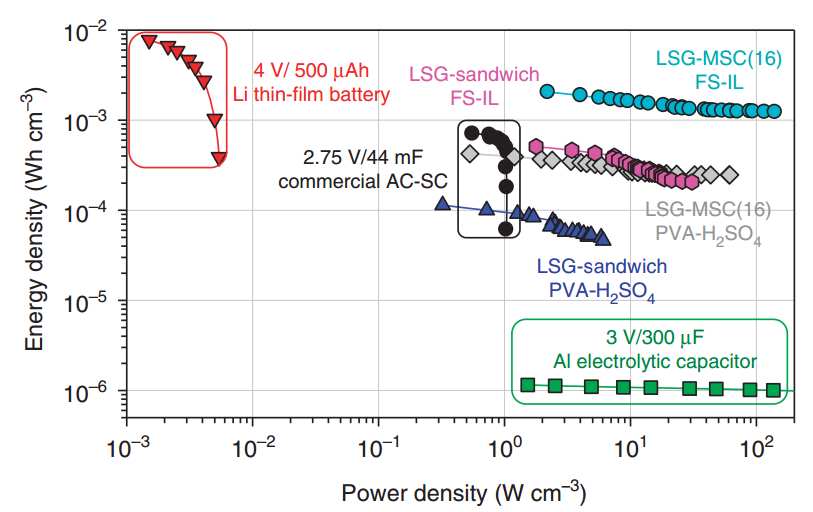
Volumetric power density ~200 uW cm^-^3; energy density three orders of magnitude higher than aluminium electrolytic capacitors; <4 % capacitance loss after 10 000 cycles; stable operation under bending.
Experimental Evidence
Figures 1-7 in the Nature Communications article show fabrication steps, SEM images, IV curves, CV profiles at scan rates up to 10 000 mV s^-^1, galvanostatic charge/discharge at 1.68 x 10^4 mA cm^-^3, impedance spectra, and self-discharge comparisons with commercial supercapacitors.
Replication Status
Demonstrated in the authors' laboratory; no independent third-party replication reported.
Limitations
- Dependence on LightScribe DVD burner technology (phasing out)
- Electrolyte voltage window limits overall energy density
- Scale-up beyond disc size not demonstrated