Goal
Treat and shrink tumors of various cancers while reducing side-effects compared with conventional aspirin.
Problem
Cancer treatment efficacy and toxicity of long-term aspirin use (ulcers, kidney failure, bleeding).
Concept Summary
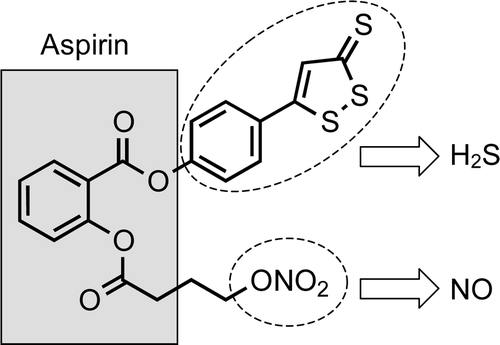
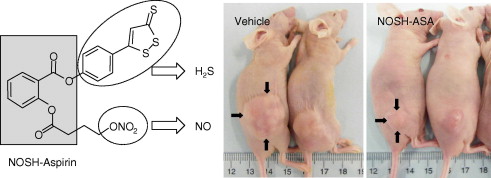
NOSH-Aspirin is a hybrid aspirin derivative that simultaneously releases nitric oxide (NO) and hydrogen sulfide (H_2S). The NO moiety protects gastric mucosa, while the H_2S moiety enhances anti-cancer activity. The compound shows dramatically higher potency than aspirin alone in vitro and reduces tumor growth in mice without observable toxicity.
Detailed Description
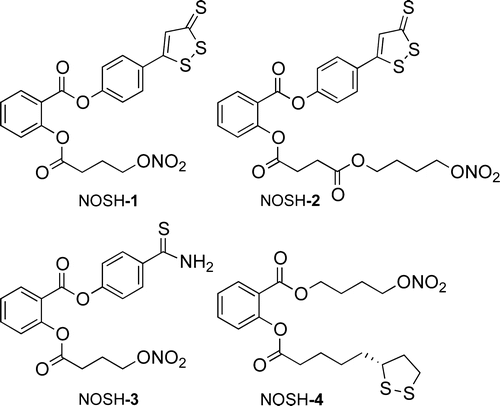
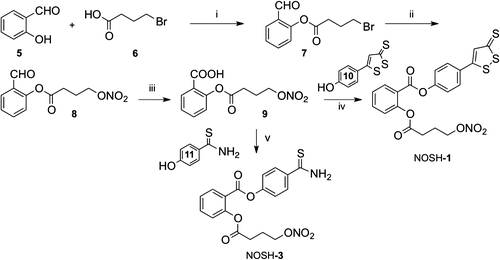
The invention describes synthesis of four NOSH compounds (NOSH-1 to NOSH-4) by coupling aspirin with a nitrate-based NO-donor and an H_2S-donor (e.g., ADT-OH, TBZ, lipoic acid). In cell-culture assays across 11 human cancer lines, the most potent, NOSH-1, exhibited an IC_5_0 of ~48 nM in HT-29 colon cancer cells and caused 85 % tumor-cell shrinkage in mouse xenograft models. Toxicity assays (LDH release) showed no damage to normal cells. The drug is intended for oral administration at lower doses than aspirin, aiming to provide anti-inflammatory and chemopreventive effects with minimal gastrointestinal toxicity.
Principles
- Hybrid drug design
- Nitric oxide release
- Hydrogen sulfide release
- Anti-inflammatory action
- Antineoplastic activity
Scientific Domains
Materials
- Aspirin (acetylsalicylic acid)
- Nitrooxy group (NO donor)
- 5-(4-hydroxyphenyl)-3H-1,2-dithiole-3-thione (ADT-OH, H_2S donor)
- 4-hydroxy-thiobenzamide (TBZ, H_2S donor)
- Lipoic acid (H_2S donor)
- Salicylaldehyde
- Succinic anhydride
- Dicyclohexylcarbodiimide (DCC)
- 4-Dimethylaminopyridine (DMAP)
- Silver nitrate (AgNO_3)
- Potassium permanganate (KMnO_4)
- Dichloromethane (solvent)
- Acetone
Mechanisms of Action
- Release of NO to protect gastric lining
- Release of H_2S to induce cancer-cell apoptosis
- Inhibition of cyclooxygenase pathways
- Modulation of cell-growth signaling
Applications
- Cancer therapy (adjuvant or primary)
- Anti-inflammatory medication with reduced GI toxicity
Claimed Performance
In mice, NOSH-Aspirin reduced tumor growth by up to 85 % and showed 100 000- to 250 000-fold greater potency than aspirin in vitro; IC_5_0 of 48 +/- 3 nM in colon-cancer cells; no observable toxicity in animal studies.
Experimental Evidence
Mouse xenograft studies showed tumor shrinkage without toxicity; in-vitro assays on 11 human cancer cell lines demonstrated nanomolar IC_5_0 values; LDH release assays indicated lack of cytotoxicity to normal cells.
Limitations
- Data limited to in-vitro and animal models
- Human safety and efficacy not yet demonstrated
- Potential unknown metabolic interactions