Goal
Generate a coherent, narrow-beam terahertz-frequency ultrasound (phonon) source.
Problem
Lack of compact, high-frequency coherent acoustic sources for terahertz applications.
Concept Summary
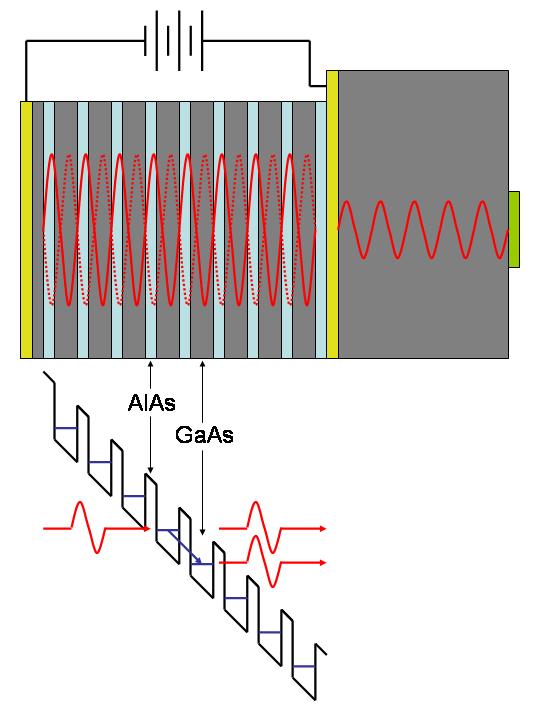
A SASER uses a superlattice of thin semiconductor quantum-well layers as the gain medium. Electrons injected into the wells emit terahertz phonons via stimulated emission. The layered structure also acts as an acoustic mirror, forming a cavity that builds up a coherent phonon beam which exits as a narrow ultrasound wave.
Principles
- stimulated emission of phonons
- quantum-well superlattice gain medium
- acoustic cavity formed by spaced semiconductor layers
Scientific Domains
Materials
- AlAs
- GaAs
- semiconductor quantum-well layers
Mechanisms of Action
- electron-phonon interaction
- phonon amplification
- acoustic reflection from periodic layer spacing
Energy Sources
Applications
- optoelectronic signal modulation
- high-resolution terahertz imaging
- non-destructive testing
- fundamental research on phonon dynamics
Claimed Performance
First SASER to reach the terahertz frequency range while using modest electrical power input.
Experimental Evidence
Bolometer measurements on a prototype device showed enhanced phonon emission when the superlattice period matched the cavity phonon energy, accompanied by a small increase in device current.
Replication Status
Prototype demonstrated; measurements reported in a 2004 Wiley-VCH paper.
Limitations
- Requires precise nanometer-scale layer thickness control
- Output power currently modest
- Device operation demonstrated only in pulsed or low-power regime